
Grind size is the single most important variable in pour-over coffee — more than your beans, your water, or your technique. Get it close to right and your pour-over will taste good. Get it really right and it'll taste like the best café in town. Here's exactly what “medium-fine” means in real terms, how to dial it in with whatever grinder you have, and how to spot when your grind is off.
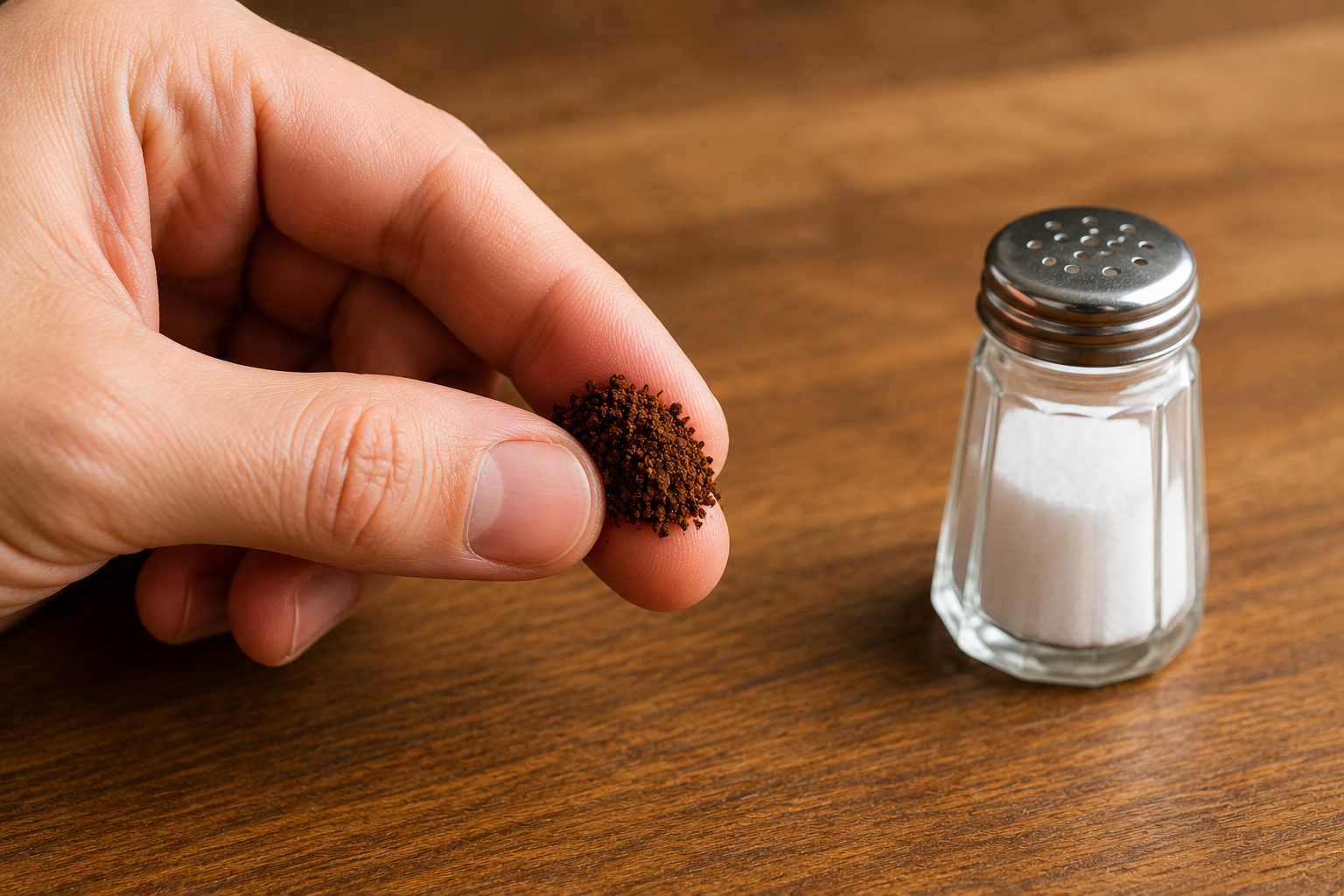
The best grind size for pour-over coffee is medium-fine — about the texture of fine table salt or beach sand. In micron terms, that's roughly 400 to 600 microns. Aim for a total brew time of 3 to 4 minutes. If your coffee is bitter, grind coarser. If it's weak and watery, grind finer.
What “Medium-Fine” Actually Means
Coffee grind sizes are described on a spectrum from extra-coarse (like cracked peppercorns) to extra-fine (like powdered sugar). Pour-over sits in the middle — finer than French press, coarser than espresso, and pretty close to standard drip coffee.
The easiest way to picture it: think about the salt and sugar in your kitchen.
- Table salt = medium-fine, the textbook pour-over grind.
- Fine beach sand = also medium-fine, slightly finer.
- Kosher salt = too coarse for pour-over (use this for French press).
- Powdered sugar = way too fine (this is espresso territory).
If you pick up a pinch of your pour-over grind and rub it between your fingers, it should feel gritty and distinct — not like flour, but not crunchy either. The individual particles should be clearly separate, not clumping.
The Micron Range (For People Who Like Numbers)
If you have a grinder with numbered settings, here's the technical range pour-over lives in:
| Method | Grind Size | Approx. Microns |
|---|---|---|
| French press | Coarse | 900–1100 |
| Drip / pour-over (Chemex) | Medium | 600–800 |
| Pour-over (V60, Kalita) | Medium-fine | 400–600 |
| AeroPress | Fine | 300–500 |
| Espresso | Very fine | 200–300 |
You don't need a $300 grinder to hit this range. Even a $25 hand grinder can get you in the 400–600 micron window with a few setting adjustments. The key is consistency — that the grounds are all in that range, not a mix of dust and chunks.
Why Grind Size Matters So Much
When hot water hits ground coffee, it pulls out flavor compounds — sugars, acids, oils, bitter notes. That's called extraction. How fast that extraction happens depends almost entirely on how finely your coffee is ground.
Finer grind = more surface area exposed to water = faster extraction.
Coarser grind = less surface area = slower extraction.
Pour-over takes about 3 to 4 minutes. In that window, medium-fine coffee extracts the good stuff (sweetness, balanced acidity, clean flavor) without going too far into bitter, over-extracted territory. Grind too coarse and you don't get enough flavor in 3 minutes — the coffee tastes thin and weak. Grind too fine and you over-extract — the coffee tastes harsh and bitter (and the water might not even drain through the dripper in time).
Brew time is the easiest way to check if your grind is right. Time from the start of your bloom until the last drip falls. Under 2:30 means too coarse. Over 4:30 means too fine. The sweet spot is 3:00 to 4:00.
How to Dial In Your Grind (Without Overthinking It)
Here's the simple process. Use a stopwatch and pay attention to two things: the brew time and how your coffee tastes.
Step 1: Start at Your Grinder's Default Pour-Over Setting
Most grinders ship with a recommended pour-over setting. Start there. If you have a numbered grinder with no label, try whatever's closest to halfway between fine and coarse.
Step 2: Brew the Core Recipe
Use 20g of coffee, 320g of water at 200°F. Time the whole brew from the start of your bloom to the last drip.
Step 3: Adjust Based on Brew Time
- Brew finished in under 2:30: grind one click finer next time.
- Brew took longer than 4:30: grind one click coarser.
- Brew finished in 3:00–4:00: taste it. If it's good, you're done. If not, see Step 4.
Step 4: Adjust Based on Taste
- Bitter, dry, harsh: over-extracted. Grind a little coarser.
- Sour, weak, watery: under-extracted. Grind a little finer.
- Balanced, sweet, clean: you've found your setting. Write it down.
This usually takes 3–4 brews to dial in for a new bag of beans. Once you've got a setting that works, stick with it until you change beans or roasters.
Burr Grinder vs Blade Grinder for Pour-Over
Honest moment: if you're using a blade grinder (the kind with spinning propeller blades), pour-over is going to be frustrating. Blade grinders chop coffee unevenly — every batch contains a mix of dust, medium pieces, and chunks. That means part of your brew is over-extracting and part is under-extracting at the same time. The result is muddled, unbalanced coffee.
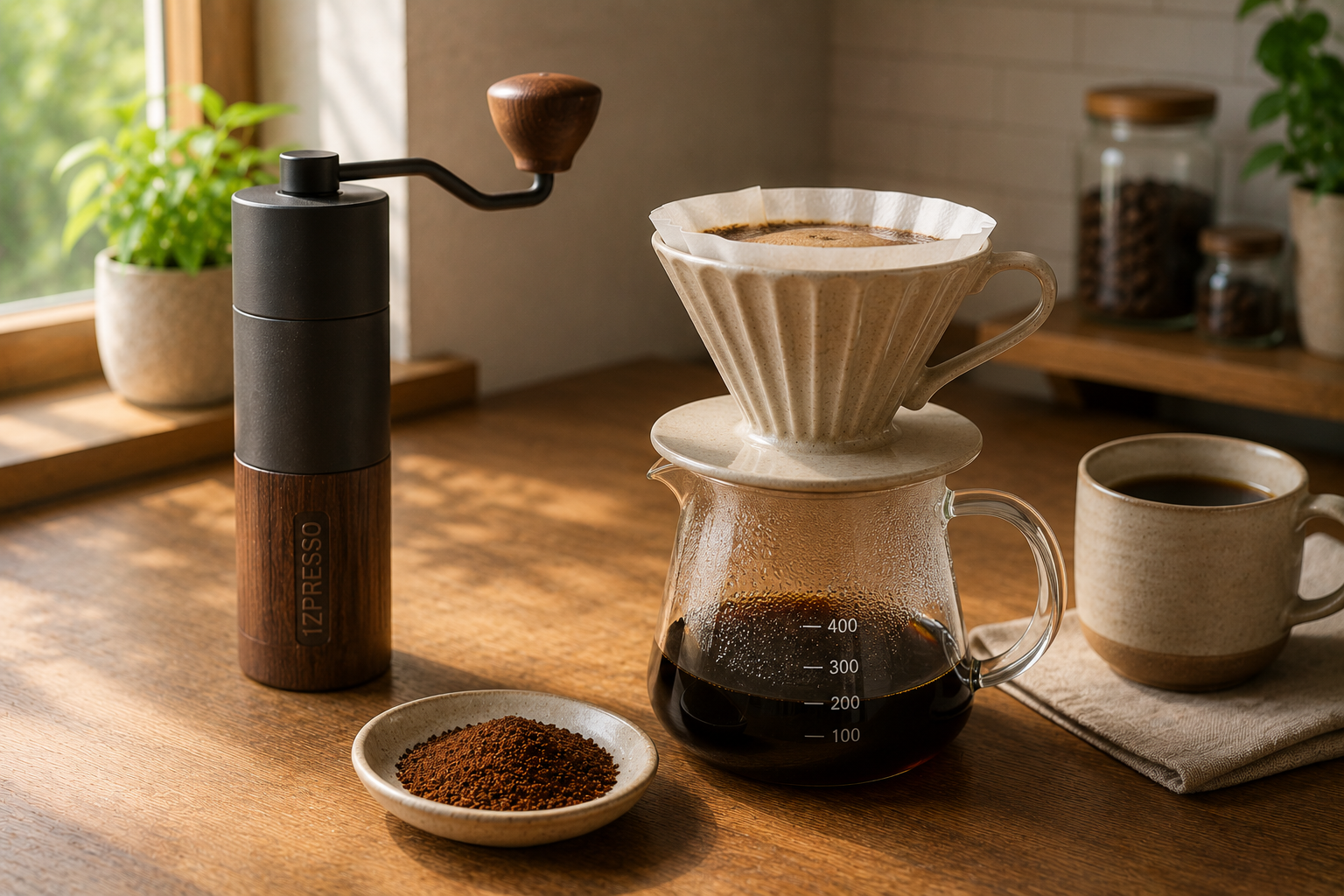
A burr grinder crushes coffee between two abrasive surfaces with adjustable spacing. Every particle comes out roughly the same size. For pour-over, that consistency makes a huge difference.
You don't need to spend a fortune. A solid hand burr grinder runs $30–$50 and will outperform a $100 blade grinder for any brew method that cares about grind size — which is all of them except maybe basic drip.
If you're getting “store-ground” coffee, ask for it ground for pour-over (or “medium-fine”). Coffee that's been pre-ground for drip is usually too coarse, and pre-ground “all-purpose” is often too fine. Ground coffee also goes stale within days, so buy small bags.
Does Grind Size Change for Different Drippers?
Yes, slightly. Here's a quick guide for the three most common pour-over drippers:
- V60: medium-fine, leaning slightly finer than table salt. The cone shape and large bottom hole need a finer grind to slow the flow.
- Chemex: medium, leaning slightly coarser than table salt. The thick paper filter slows things down on its own, so a coarser grind balances it out.
- Kalita Wave: medium-fine, very close to table salt. The flat bottom and small holes are forgiving — most grinds in the right range will work.
Start at “table salt texture” no matter which dripper you have. Then adjust based on brew time and taste.
Quick Troubleshooting Guide
| Problem | Likely Cause | Fix |
|---|---|---|
| Bitter, harsh taste | Grind too fine | Grind one step coarser |
| Sour, weak, watery | Grind too coarse | Grind one step finer |
| Brew time under 2 minutes | Grind too coarse | Grind finer |
| Brew time over 5 minutes | Grind too fine | Grind coarser |
| Water sitting on top, won't drain | Way too fine | Grind much coarser |
| Water blasts through too fast | Way too coarse | Grind much finer |
- The best grind size for pour-over is medium-fine — about the texture of fine table salt.
- In micron terms: 400–600 for V60 and Kalita, 600–800 for Chemex.
- Use brew time as your guide — aim for 3 to 4 minutes total.
- Bitter = grind coarser. Weak or sour = grind finer.
- A burr grinder (even a $30 hand grinder) will make a huge difference vs a blade grinder.
Want to Go Deeper?
Now that you've got grind dialed in, lock in the other variables. Start with our complete pour-over guide for the full beginner walkthrough, then check out our visual grind size guide if you want to see exactly what each size looks like in detail.
☕ About the Author
Greg Rathbone is the founder of HomeCoffeeBeginner.com. He started this site after finding that most coffee advice online assumed you were already an expert. Every guide here is written for total beginners — tested in his own kitchen in Oklahoma, with zero snobbery.