
Getting the coffee-to-water ratio right is the single biggest factor in how your coffee tastes. Too little coffee and it's weak and sour. Too much and it's bitter and muddy. Nail the ratio and even an inexpensive drip machine can make a cup you're genuinely excited about.
Use the free coffee brew ratio calculator below to get an exact recipe for your brew method, roast level, and batch size. Pick a method, tell us your roast, enter how many cups (or how much water) you want, and we'll show you the grams of coffee, grams of water, grind size, brew time, and water temperature — with no math on your part.
Quick Answer:
For most beginners, a 1:16 coffee-to-water ratio is a great starting point — that's 1 gram of coffee for every 16 grams of water. A French press works better a little stronger (1:15), pour-over stays right around 1:16, and a drip machine does best slightly lighter (1:17). The calculator below adjusts automatically so you don't have to memorize the numbers.
How to use this calculator
- Pick your brew method. French press, pour over, AeroPress, drip machine, Moka pot, or cold brew. Each one needs a different ratio — the calculator handles that for you.
- Pick your roast level. Light, medium, or dark. Not sure? Stick with medium — that's what most grocery-store bags are. The calculator nudges the recipe slightly for light or dark roasts.
- Tell it how much you want to make. Either pick how many cups, or enter a specific amount of water. Your full recipe appears below.
New to coffee measurement? Don't worry about grams yet — just start with the recipe the calculator gives you, brew it, and taste. You'll dial in your preferences quickly.
Coffee Brew Ratio Calculator
Pick your brew method and we'll tell you the perfect coffee-to-water ratio.
Your Recipe
—
Enter a water amount above to see your recipe.
Like the calculator? Print the cheat sheet.
Get all 6 brew ratios, grind sizes, water temps, and no-scale conversions on one printable page. Stick it on the fridge — I'll email it over.
- ✓ All 6 ratios (French press, pour over, AeroPress, drip, Moka pot, cold brew)
- ✓ Grind size reference + water temp for every method
- ✓ Troubleshooting guide — what to fix when it tastes bitter or sour
- ✓ Tablespoon conversions if you don't have a scale yet
No spam, just coffee. Unsubscribe anytime.
Why coffee ratios matter so much
Coffee brewing comes down to one simple idea: water pulls flavor out of ground coffee. The ratio — how much coffee you put in versus how much water — decides how much flavor gets pulled out and how strong the final cup is.
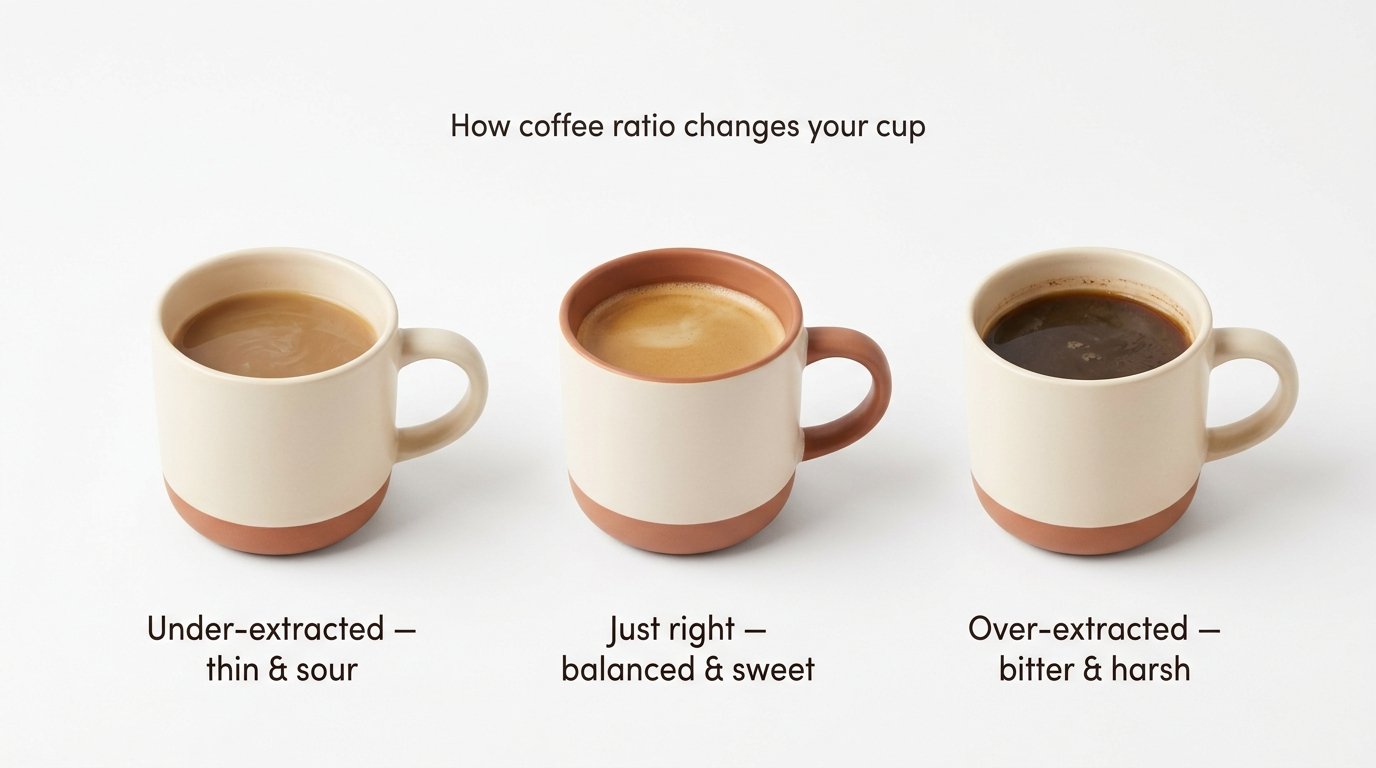
Use too little coffee for the amount of water and you get under-extraction. The water doesn't have enough coffee to grab flavor from, so you end up with a thin, watery, sometimes weirdly sour cup. It tastes like something is missing — because it is.
Use too much coffee and you get over-extraction. The water pulls out all the good stuff, then keeps going and grabs the bitter compounds too. The cup tastes harsh, ashy, or muddy. If your coffee has ever made you wince, over-extraction is usually why.
The sweet spot — the part where your coffee tastes balanced, sweet, and clean — is narrower than you'd think. Moving the ratio by just a gram or two in either direction can flip a cup from "really good" to "something's off." That's why a calculator like this one is useful: it gets you into the sweet spot on the first try, so you're not guessing every morning. For a deeper look at why this happens, read our guide on what coffee extraction is and why it matters.
Common coffee brew ratios explained
You'll see ratios written like 1:15 or 1:16 on coffee bags, in recipes, and on sites like this one. The first number is coffee, the second is water. A lower second number means stronger coffee. A higher number means lighter coffee. Here's the quick cheat sheet:
| Ratio | Strength | Best for |
|---|---|---|
| 1:14 | Very strong, full-bodied | Fans of bold French press or cold brew concentrate |
| 1:15 | Strong and rich | Classic French press and AeroPress recipes |
| 1:16 | Balanced "golden ratio" | Pour over, most specialty recipes — great starting point |
| 1:17 | Lighter, smoother | Standard drip coffee makers |
| 1:18 | Mild and clean | SCA Gold Cup standard, lighter roasts |
The Specialty Coffee Association officially centers its "Gold Cup" standard around 1:18, but most home brewers prefer something a little stronger. That's why our calculator defaults to 1:15 for French press and 1:16 for pour over — those are the ratios most beginners find most enjoyable.
Pro Tip:
If your coffee tastes too weak even after using the calculator's recipe, try moving the ratio one step stronger (e.g., 1:16 → 1:15). If it tastes too strong or bitter, try one step lighter (e.g., 1:15 → 1:16). Small changes, one at a time — that's how you dial in your perfect cup.
Coffee ratios by brew method
Each brewing method has its own ideal ratio because of how the water contacts the coffee and how long it stays there. Here's a quick reference — and links to our full guides for each method:
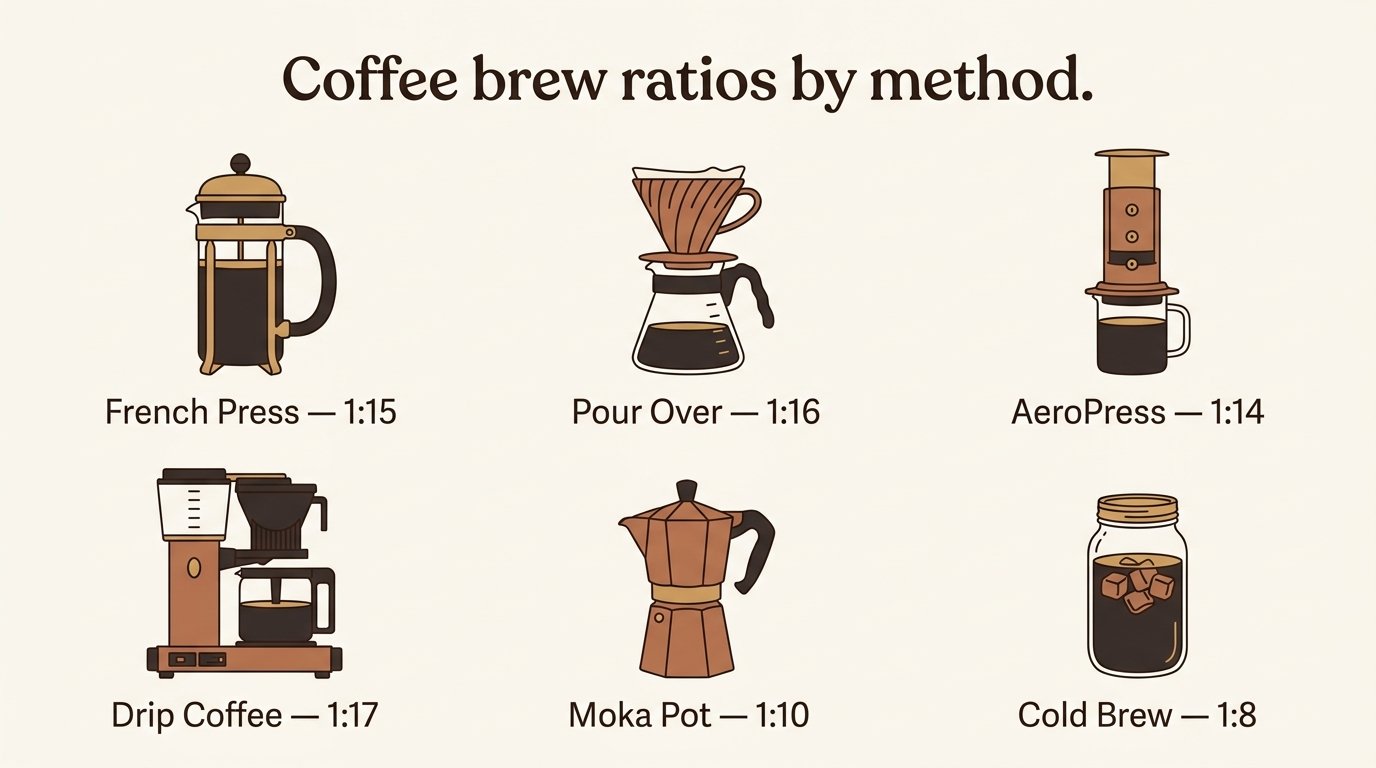
- French press — 1:15. Full-bodied, rich, coarse grind, 4-minute steep. See our complete French press guide.
- Pour over — 1:16. Clean, bright, medium-fine grind, 3–4 minute pour. See our pour-over beginner's guide.
- AeroPress — 1:14. Smooth and quick, fine-medium grind, 1.5–2 minutes total. Read why we love the AeroPress for beginners.
- Drip coffee maker — 1:17. The classic auto-brew ratio, medium grind, 5–6 minutes. See our picks for the best beginner drip coffee makers.
- Moka pot — 1:10. Espresso-style and concentrated, fine grind, stovetop start. See why the Moka pot is a great beginner step up.
- Cold brew — 1:8. Smooth and low-acid, extra-coarse grind, 12–18 hour steep.
How to measure coffee without a scale
The most accurate way to measure coffee is by weight in grams. But if you don't own a kitchen scale yet, you can still use tablespoons as a rough guide while you get started. One level tablespoon of medium-ground coffee is about 5 grams.
Here's a quick conversion table if you're using tablespoons:
| Water amount | Coffee by weight (1:16 ratio) | Coffee by volume (approx.) |
|---|---|---|
| 6 fl oz (180 ml) — 1 cup | ≈ 11 g | About 2 level tablespoons |
| 12 fl oz (360 ml) — 2 cups | ≈ 22 g | About 4 level tablespoons |
| 24 fl oz (720 ml) — 4 cups | ≈ 45 g | About 9 level tablespoons |
| 48 fl oz (1,440 ml) — 8 cups | ≈ 90 g | About 18 level tablespoons |
Watch Out:
Tablespoon measurements are rough. A tablespoon of light-roast beans weighs more than a tablespoon of dark-roast beans because dark roasts are less dense. Finely ground coffee packs tighter than coarsely ground coffee. If your coffee tastes inconsistent from day to day, the tablespoon is probably the reason — and a cheap kitchen scale is the fix.
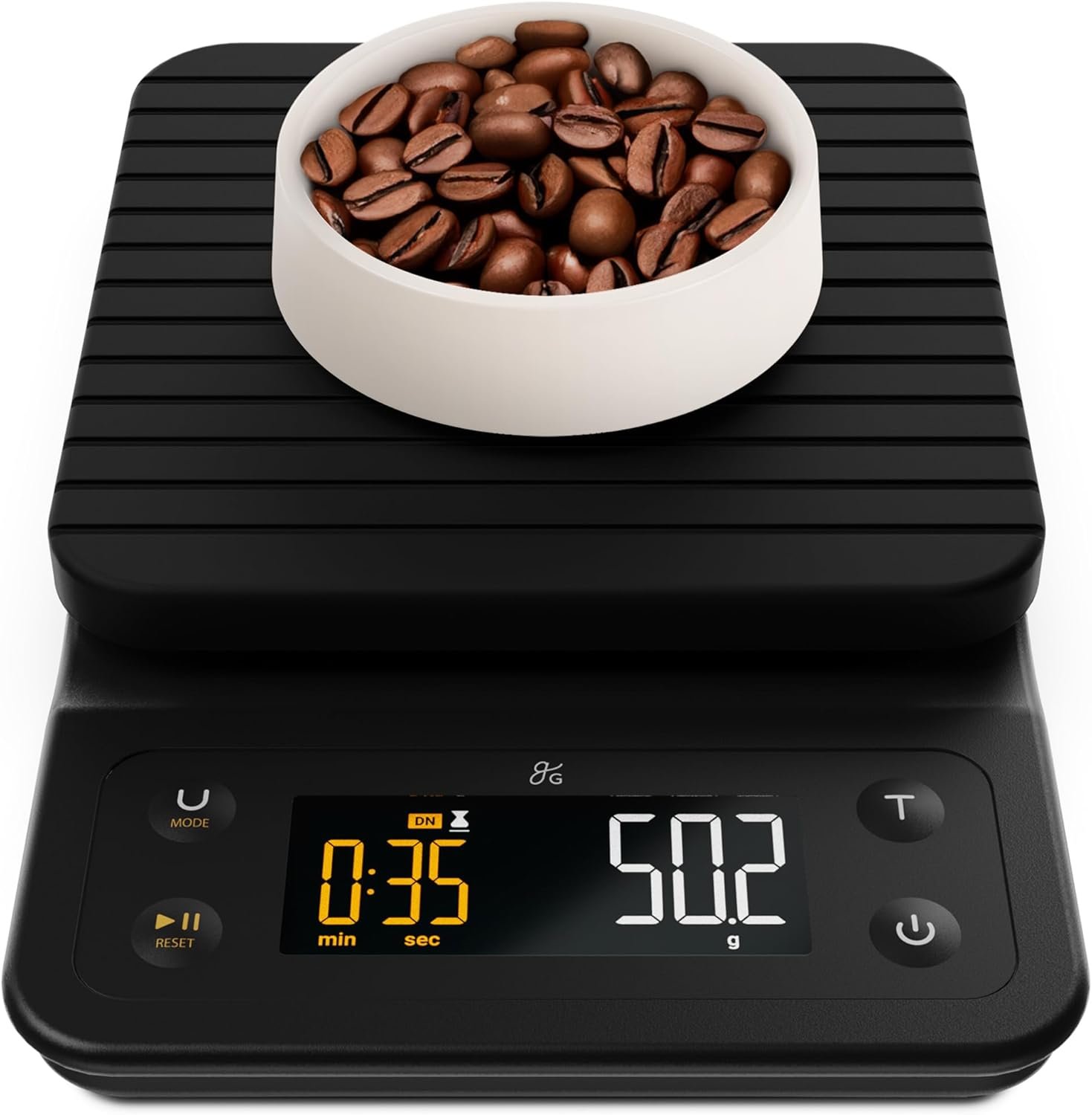
A kitchen scale is the single best $20–30 upgrade you can make to your home coffee setup. It lets you hit the exact recipe the calculator gives you, every time, regardless of roast level or grind size. We break down why it matters so much in our article on why you need a scale to make good coffee.
Our Pick for Beginners
Greater Goods Coffee Scale
0.1g precision, built-in brew timer, waterproof cover. Everything you need to hit the calculator's recipe exactly — for under $30. No apps, no fuss.
Check Price on Amazon →Frequently asked questions
What is the golden ratio for coffee?
The "golden ratio" is the Specialty Coffee Association's recommendation of about 1:18 — one gram of coffee for every 18 grams of water. Most home brewers find that a little weak, though, which is why most modern recipes (and this calculator) default to 1:15 to 1:17 depending on method. Any ratio in that 1:15 to 1:18 window is considered balanced.
How many tablespoons of coffee per cup?
For a standard 6-ounce "coffee cup," use about 2 level tablespoons of medium-ground coffee. For a larger 8-ounce mug, use closer to 2½ tablespoons. A tablespoon weighs roughly 5 grams of coffee, but weight varies with roast and grind — so measure by grams when you can.
How much coffee do I need for 4 cups?
Using the standard 1:16 ratio, 4 cups (about 720 ml of water) calls for roughly 45 grams of coffee — that's about 9 level tablespoons. For a stronger brew like French press, bump that up to 48 grams. For a drip machine, 42 grams is plenty. The calculator above does this math automatically for any cup count.
Does grind size change the ratio?
No — grind size doesn't change the coffee-to-water ratio. But it does change how fast the water extracts flavor, which affects how the cup tastes. A too-fine grind over-extracts and tastes bitter even at the right ratio. A too-coarse grind under-extracts and tastes sour. Match your grind to your brew method and use the calculator's ratio, and you'll be in good shape. For a full breakdown, see our coffee grind sizes guide.
Should I use more coffee for dark roast?
Actually, the opposite — most baristas recommend a slightly lighter ratio (less coffee) for dark roasts, because dark roasts extract faster and can turn bitter. Light roasts benefit from slightly more coffee because they extract slower. The calculator handles this automatically when you pick a roast level. If you're unsure what roast you have, see our guide to light, medium, and dark roast differences.
What's the best coffee-to-water ratio for beginners?
Start at 1:16 — one gram of coffee per 16 grams of water. It's balanced, forgiving, and works well with most beans and brewing methods. Brew it as the calculator suggests, taste it, and adjust one step in either direction next time. Stronger? Try 1:15. Lighter? Try 1:17. Within three or four brews, you'll know exactly what you like.
Do I need a scale to use this calculator?
A scale makes the calculator much more accurate, but no, you don't have to have one. You can use the tablespoon conversion table above as a rough guide, or use the "By Water Amount" input mode to match the ml or fl oz markings on your coffee maker's water tank. But if you want the cup to taste the same every morning, a scale is the biggest quality upgrade you can make for the lowest cost.
Can I use this calculator for espresso?
Not yet — espresso works differently from filter coffee. It uses a weight-in / weight-out ratio (how much ground coffee goes in versus how much liquid espresso comes out), and the numbers are much tighter — typically 1:2 for a standard shot. We're working on a dedicated espresso ratio calculator. In the meantime, you can use this one for any filter-style brew method.
Key Takeaways:
- The coffee-to-water ratio is the single biggest factor in how your cup tastes — get this right and everything else is easier.
- Start at 1:16 for most brewing methods. Go a little stronger (1:15) for French press, a little lighter (1:17) for drip machines.
- The calculator above picks the right ratio for your method and adjusts for roast level automatically.
- A $20–30 kitchen scale is the biggest upgrade you can make — it turns the calculator's recipe into a cup you can repeat every day.
- Taste your coffee, then adjust the ratio one step at a time until you love it.
Don't want to come back here every morning?
I'll email you the printable one-page cheat sheet — all the ratios, grinds, and temps you just read about. Stick it on the fridge and you're set.
Free. No spam. Unsubscribe anytime.
Related guides
- Coffee-to-water ratio: the simple guide for beginners — the full written companion to this calculator.
- Why you need a scale to make good coffee — why weighing beats scooping every time.
- What is coffee extraction (and why it matters) — the science behind why small ratio changes create big flavor swings.
- Coffee grind sizes explained — the other half of the equation.
- Complete beginner's coffee setup guide — everything you need to start brewing at home.
Disclosure: This article contains affiliate links. If you purchase through our links, we may earn a small commission at no extra cost to you. We only recommend products we genuinely believe are right for beginners. Full disclosure here.