
Coffee grind sizes range from extra coarse to extra fine — and the right size depends entirely on your brewing method. Coarser grinds suit slow methods like French press and cold brew. Finer grinds suit fast, high-pressure methods like espresso. Using the wrong grind is one of the most common reasons home coffee tastes off.
You brewed a pot of coffee, took your first sip, and something was wrong. Maybe it tasted bitter and harsh. Maybe it was thin and sour, like watered-down tea. You measured the coffee carefully, used fresh beans, followed the instructions — so what went wrong?
Nine times out of ten, the answer is grind size. It's the one variable that changes everything about how your coffee extracts and tastes, yet nobody really explains it to beginners. The bag says “medium grind” and leaves you to figure out the rest.
In this guide, we're going to walk you through the complete coffee grind size spectrum — what each size looks like, which brewing methods it belongs to, and exactly why it matters for your cup. By the end, you'll understand one of the most important variables in home coffee, and you'll have a clear starting point for every brewing method you try.
What Are Coffee Grind Sizes?
Grind size refers to how coarsely or finely your coffee beans are ground before brewing. It sounds simple, but it has an outsized effect on your final cup — because grind size directly controls how quickly water extracts flavor from the coffee.
Here's the core idea: when you grind a coffee bean, you're creating surface area. A fine grind produces thousands of tiny particles, each with lots of surface area exposed to the water. A coarse grind produces fewer, larger pieces with less surface area exposed. More surface area means faster extraction. Less surface area means slower extraction.
Every brewing method has an ideal extraction rate based on how long water stays in contact with the coffee grounds. Match the grind to the method, and you get a balanced, flavorful cup. Mismatch them, and you get bitterness, sourness, or something that just doesn't taste like much at all.
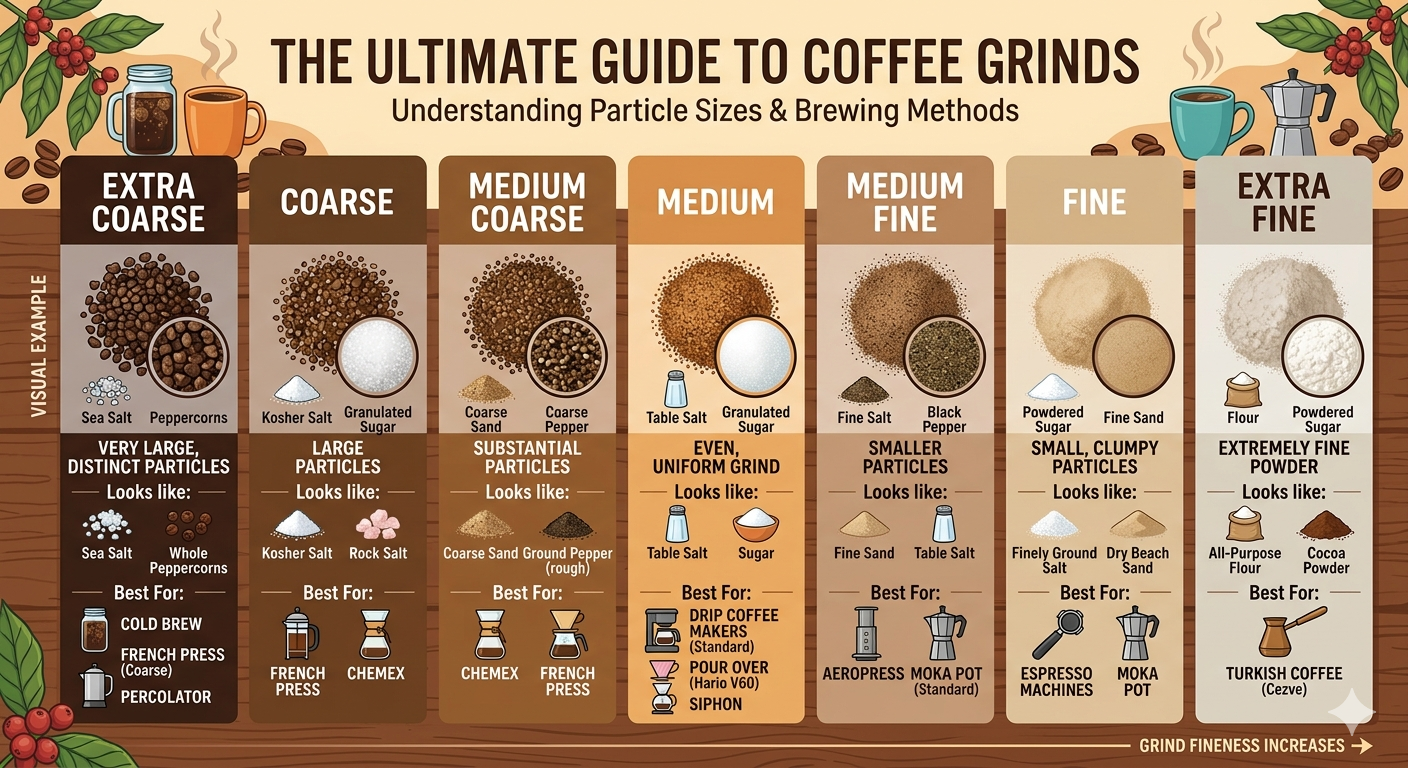
There are seven grind sizes you'll encounter in home brewing, running from extra coarse all the way down to extra fine. Here's the full picture:
| Grind Size | What It Looks Like | Best For |
|---|---|---|
| Extra Coarse | Large breadcrumbs / rough pebbles | Cold brew, cowboy coffee |
| Coarse | Kosher salt / sea salt | French press, percolator |
| Medium-Coarse | Rough, uneven sand | Chemex, flat-bottom pour-over (Kalita Wave) |
| Medium | Smooth beach sand | Drip coffee maker, siphon |
| Medium-Fine | Fine beach sand, slightly powdery | V60 pour-over, Moka pot, AeroPress (2–3 min steep) |
| Fine | Table salt / fine granulated sugar | Espresso machine |
| Extra Fine | Flour / talcum powder | Turkish coffee |
The Coffee Grind Sizes — One by One
Extra Coarse — Cold Brew and Cowboy Coffee
Extra coarse is as chunky as coffee gets. You can still make out distinct pieces that look like rough breadcrumbs or small pebbles. This grind is used almost exclusively for cold brew — coffee that steeps in cold or room-temperature water for 12 to 24 hours. Because there's no heat to speed things up, the very long contact time does the work instead. Grind any finer for cold brew and you'll end up with a bitter, harsh concentrate that no amount of ice can fix.
Coarse — French Press and Percolators
A coarse grind looks like kosher salt — large, uneven chunks with a noticeably rough texture. This is the grind for French press, one of the most beginner-friendly brewing methods out there. For a full walkthrough, see our step-by-step French press guide, and for help dialing in the exact grind, check our French press grind size guide. French press uses a metal mesh filter to separate grounds from liquid, and that mesh has relatively large holes. A coarse grind keeps the grounds where they belong (below the plunger) and gives you a full-bodied, satisfying cup without a muddy, gritty texture.
Medium-Coarse — Chemex and Flat-Bottom Pour-Overs
Medium-coarse sits just between coarse and medium — rough, uneven sand is the best description. This grind is designed for the Chemex and flat-bottom pour-over brewers like the Kalita Wave. The Chemex uses an unusually thick paper filter that slows water flow significantly. A medium-coarse grind allows the water to move through at the right pace without getting stuck and over-extracting a bitter, heavy brew.
Medium — Drip Coffee Makers
Medium is the most common grind size in the world, and for good reason — it's designed for automatic drip coffee makers, which are by far the most popular brewing method at home. It looks like smooth, uniform beach sand. When you buy pre-ground coffee at the grocery store and it doesn't specify a grind, it's almost certainly medium. If you have a standard drip machine on your counter, medium is exactly where you want to be.
Medium-Fine — V60 Pour-Over, Moka Pot, and AeroPress
Medium-fine is noticeably smoother than regular sand — almost like very fine lake sand that's slightly clumping. This grind is the sweet spot for cone-shaped pour-overs like the Hario V60, Moka pots, and AeroPress with a 2–3 minute steep time.
The Moka pot is a great illustration of why this matters. It works by forcing pressurized steam up through the grounds to produce a strong, concentrated coffee. The grind needs to be fine enough to create some resistance for the steam, but not so fine that it clogs the filter basket entirely. Medium-fine hits that balance — strong flavor, clean cup, no mess.
Fine — Espresso
Fine grind looks like table salt or fine granulated sugar. This is the grind for espresso machines, and it's where most beginners get tripped up — because fine really is fine. It looks almost powdery compared to what goes in a drip machine.
Espresso forces hot water through tightly packed grounds at around 9 bars of pressure in just 25–30 seconds. That extremely short brew time means the water needs maximum surface area to extract enough flavor — and that requires very fine grounds. The fine grind also creates resistance against the water pressure, which is what produces the signature golden crema on top of a well-pulled shot.
Extra Fine — Turkish Coffee
Extra fine is a true powder — it looks and feels like flour. Very few home grinders can reach this level, and a blade grinder definitely can't produce it consistently. Extra fine is used exclusively for Turkish coffee, where the powder-like grounds are simmered directly in a small pot called a cezve and served unfiltered. The grounds settle to the bottom of the cup, giving Turkish coffee its thick, intensely concentrated character.
Why Grind Size Makes or Breaks the Taste of Your Coffee
Here's the simple version of the science: grind size controls how fast water pulls flavor out of your coffee. Fine grounds extract fast. Coarse grounds extract slowly. And every brewing method has a “Goldilocks zone” — an extraction rate that produces a balanced, flavorful cup.
When you mismatch grind and method, the result shows up immediately:
- Too coarse for your method: The water rushes through without pulling enough flavor. The result is under-extraction — coffee that tastes sour, thin, and weak, almost like tea with a vague coffee flavor.
- Too fine for your method: The water lingers too long and pulls harsh, unpleasant compounds from deep in the grounds. The result is over-extraction — coffee that tastes bitter, dry, and astringent.
This is why grind size is always the first thing to check when your coffee doesn't taste right. Before you switch beans, adjust your water temperature, or change your brew ratio — check your grind. It fixes a surprising number of problems.
Espresso is the most grind-sensitive brewing method by far. If your shots taste sour and run through the portafilter too quickly, grind finer. If they taste bitter and drip out painfully slowly — or stall completely — grind coarser. Even a half-step adjustment on your grinder can make a noticeable difference in the cup.
The Biggest Grind Size Mistakes Beginners Make
Understanding grind size is one thing — actually applying it correctly is another. Here are the mistakes we see beginners make most often.
Using pre-ground coffee with the wrong brewing method. Pre-ground coffee is almost always ground to medium, which is optimized for drip machines. If you're using a French press, that medium grind is too fine — it'll slip through the metal filter and make your coffee gritty and over-extracted. Always check whether the grind on the bag matches your brewing method.
Grinding all their coffee the same way. If you have both a drip machine and a French press, those two methods need two different grinds. Many beginners pick one setting and use it for everything, then wonder why one brew always tastes off. If you own more than one brewing method, adjust your grind each time.
Expecting a blade grinder to produce consistent results. This one matters enough to call out separately.
Blade grinders (the inexpensive spinning-blade style) chop beans unevenly, producing a random mix of fine powder and large chunks in every batch. This means some grounds over-extract while others under-extract simultaneously — giving you a cup that somehow manages to taste both bitter and sour at once. If inconsistent grind size is your problem, a blade grinder is the cause. A burr grinder solves it.
How to Get the Right Grind Every Time
The simplest thing you can do right now is match your grind to your brewing method using the chart above. If you have a drip machine, use medium. French press? Coarse. Espresso machine? Fine. Start there, and you've already eliminated one of the most common causes of bad coffee at home.
If you're buying pre-ground coffee, check the label. Most bags will say “coarse,” “medium,” or “espresso grind.” If it doesn't specify, assume medium — and keep that in mind if you're using it in anything other than a drip machine.
If you want full control over your grind size — and the ability to dial in each method exactly — you'll need a grinder. A burr grinder is the right tool for the job. Unlike a blade grinder, a burr grinder crushes beans between two abrasive surfaces to produce a consistent, uniform particle size at whatever setting you choose. That consistency is what actually makes a measurable difference in your cup.
We've pulled together the best options at every price point in our guide to Best Coffee Grinders for Beginners. It covers everything from $40 entry-level picks to the grinders worth upgrading to once you're hooked.
And if you're still building out your home coffee setup from scratch, our guide What Do You Need to Make Coffee at Home? is a good place to start. It breaks down the essentials at every budget so you're not buying more than you need.
- Coffee grind sizes run from extra coarse (cold brew) to extra fine (Turkish coffee) — medium is the default for most drip coffee makers.
- Grind size controls extraction speed. Coarser grinds extract slowly; finer grinds extract fast. Matching the grind to your brew method is what produces a balanced cup.
- If your coffee tastes sour or weak, try a finer grind. If it tastes bitter or harsh, try a coarser grind.
- Pre-ground coffee is almost always medium — optimized for drip machines and potentially wrong for everything else.
- Blade grinders produce uneven particle sizes that cause simultaneous over- and under-extraction. A burr grinder is the upgrade that solves this problem.
The Bottom Line on Coffee Grind Sizes
Grind size might seem like a technical detail best left to coffee nerds, but it's actually one of the most practical pieces of knowledge you can have as a home brewer. Once you understand how it works — and why each brewing method needs a specific grind — a lot of the mystery behind inconsistent coffee suddenly disappears.
Start simple: medium for drip, coarse for French press, fine for espresso. Use those as your baselines, and adjust based on taste. That's the approach that turns a frustrating, unpredictable cup into one you look forward to every morning.
Ready to go deeper? If you've been wondering whether grinding your own coffee is actually worth it, we break it all down in Do You Need a Coffee Grinder? — including exactly when it makes sense to invest and what to look for at every budget.
☕ About the Author
Greg Rathbone is the founder of HomeCoffeeBeginner.com. He started this site after finding that most coffee advice online assumed you were already an expert. Every guide here is written for total beginners — tested in his own kitchen in Oklahoma, with zero snobbery.
⚙️ Related Coffee Grinder Guides