
If you've been thinking about making better coffee at home, a French press is one of the easiest places to start. It's affordable, nearly unbreakable, and doesn't require any special skill or fancy gear. Pour, wait, press, drink. That's really it.
But if you've ever had gritty, bitter, or weak French press coffee, you already know there's a little more to it than that. The good news? The fixes are simple, and once you know them, you'll make great coffee every morning without thinking twice.
This is our complete beginner's guide to French press coffee. We'll walk you through how it works, why it's so forgiving, the exact ratio and grind size to use, how long to steep, and what to do when something goes wrong. We've also linked to deeper guides throughout, so you can explore each topic at your own pace.
You don't need to read this all at once. Bookmark it, come back when you have questions, and use it as your home base for anything French press.
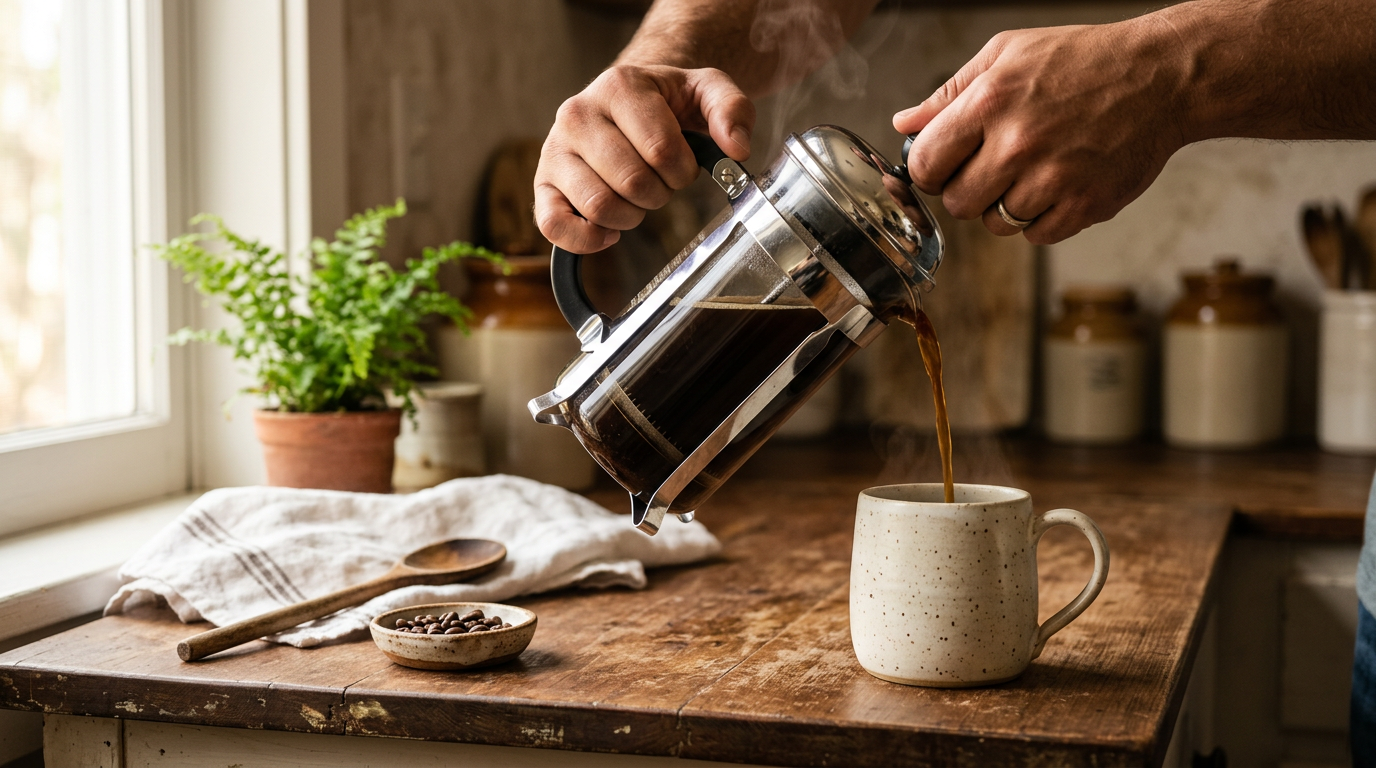
French press coffee is made by steeping coarsely ground coffee in hot water for four minutes, then pressing a mesh plunger down to separate the grounds. Use a 1:15 ratio (1 gram of coffee for every 15 grams of water), water at about 200°F, and a coarse grind that looks like kosher salt. It's one of the most forgiving brewing methods for beginners because there's no timing window to nail, no paper filter to fold, and no expensive equipment to buy.
Your Complete French Press Guide
This pillar covers the big picture. For deeper dives into each topic, we've written focused guides you can jump to whenever you need them:
- How to Use a French Press: Step-by-Step for Beginners — The exact routine, start to finish.
- Best Grind Size for French Press (With Visual Guide) — What “coarse” actually looks like, with a visual guide.
- French Press Coffee-to-Water Ratio (Simple Chart) — Simple chart for any size French press.
- How Long to Steep French Press Coffee (And Why It Matters) — Why four minutes, and what happens if you go over.
- Why Is My French Press Coffee Muddy? — The five most common causes, and how to fix each one.
- How to Clean a French Press (Without Breaking It) — The right way, plus one common mistake that ruins carafes.
- French Press vs Drip Coffee — Which is actually better for a beginner?
- Best French Press for Beginners (2026 Picks) — Our top recommendations at every budget.
What Is a French Press, Really?
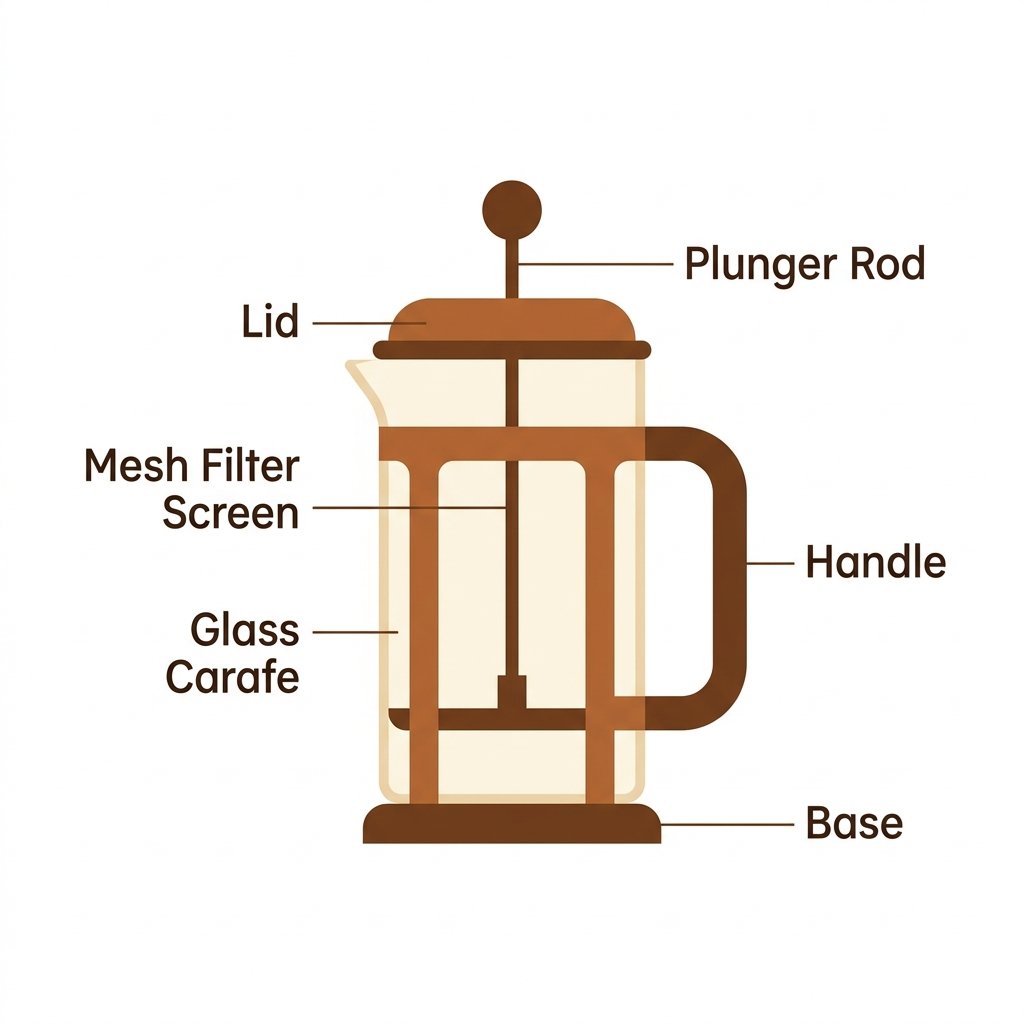
A French press is a manual coffee maker. There's no electricity, no pods, no paper filters — just a tall glass or stainless steel carafe, a metal mesh plunger, and a lid. You add ground coffee and hot water to the carafe, wait a few minutes, then push the plunger down to separate the grounds from the liquid. What's left on top is your coffee.
The method is called immersion brewing. The grounds are fully submerged in water the entire time they're steeping, which is why the French press makes such a rich, full-bodied cup. Because the filter is a metal mesh (not paper), the coffee's natural oils and some very fine particles stay in the finished cup. That's what gives French press coffee its signature heavy, almost silky texture.
Despite the name, the French press wasn't really invented in France in the way you might think. Two Frenchmen patented an early version in 1852, but the modern design we all use today was patented by two Italians — Attilio Calimani and Giulio Moneta — in 1928. The name stuck anyway. You'll also hear it called a press pot, cafetière, or plunger pot depending on who you're talking to. They're all the same thing.
Why French Press Is Great for Beginners
If you're new to home coffee, the French press has a few big things going for it. Most of them come down to one word: forgiving.
Here's what we mean. With a pour-over, your timing and pour speed matter a lot — pour too fast or too slow and the coffee tastes off. With espresso, you're measuring grind size to the gram and timing your shot to the second. The French press doesn't ask you to do any of that. You're not pouring continuously. You're not adjusting in real time. You just add water, wait, and press.
A few specific reasons we recommend it to new coffee drinkers:
- It's cheap to buy. A solid beginner French press costs between $20 and $40. Some of the best ones have been made the same way for decades.
- There's almost nothing to break. A glass carafe (fragile) plus a metal plunger (basically indestructible). Stainless steel versions exist if you're worried about glass.
- You don't need paper filters. The metal mesh is permanent. That's less waste, less cost, and one fewer thing to run out of.
- No electricity required. It works anywhere you can boil water — camping, traveling, a kitchen without a coffee maker.
- Variables are easy to understand. Grind, ratio, time, temperature. Change one, taste the difference. Great for learning how coffee actually works.
There's one honest trade-off to know about: French press coffee has more sediment in the cup than drip or pour-over. That's the oil and fine particle story we mentioned — it's a feature, not a bug, but it's different. If you're used to the super-clean cup a paper filter gives you, it takes a few brews to get used to. (For a side-by-side breakdown, see our French press vs drip coffee comparison.)
The best single thing a new French press user can do is buy a burr grinder (or use whole beans freshly ground at the store on the “coarse” setting). A bad grind is the number one reason French press coffee tastes muddy or bitter — and it's the easiest fix. We cover this more in our Do You Need a Coffee Grinder? guide.
What You Need to Get Started
Let's keep this simple. Here's the full starter kit for French press coffee at home.
| Item | What It Does | Approx. Price | Priority |
|---|---|---|---|
| French press | The brewer itself. 32 oz / 1 liter is the best all-around size. | $20–$60 | Essential |
| Fresh whole bean coffee | Medium or medium-dark roast works great for beginners. | $12–$18 per bag | Essential |
| A way to grind coffee | A burr grinder at home, or coarse-ground at the store. | $40–$100 (optional at store) | Very helpful |
| Kitchen scale | Lets you measure coffee and water by weight for consistent results. | $15–$25 | Recommended |
| Kettle | Any kettle works. A gooseneck isn't needed for French press. | $20–$40 | Essential |
| Timer | Your phone works fine. | Free | Essential |
That's the whole list. You can start brewing excellent coffee with just the French press, beans, a kettle, and your phone timer. A scale and grinder are upgrades that make everything easier and more consistent — worth adding once you know you'll stick with the French press.
For a broader look at everything you might want in your home coffee setup, see our Complete Beginner's Coffee Setup Guide.
Our pick for a beginner French press
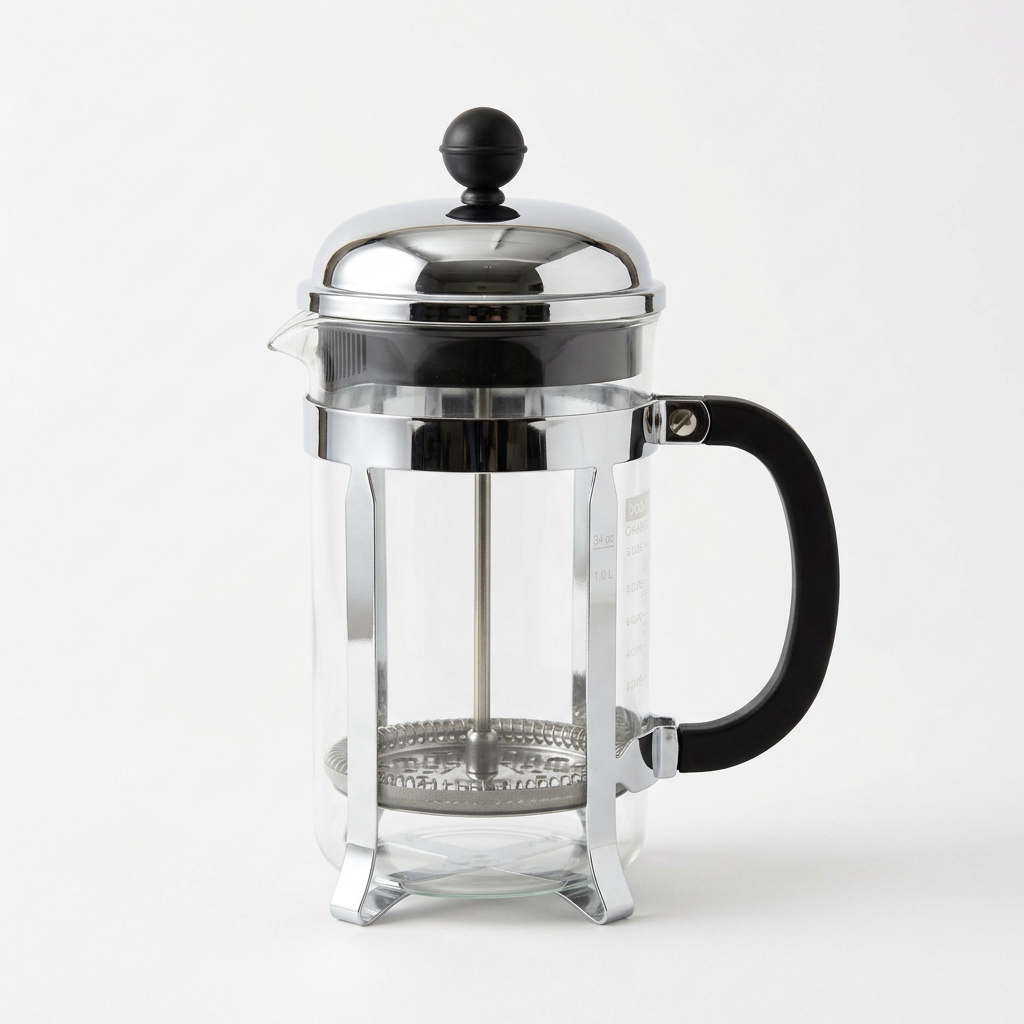
After testing a lot of beginner options, the Bodum Chambord is the one we recommend most often. It's been around for decades, looks nice enough to leave on the counter, and costs about the same as a couple of lattes.
Our Pick for Beginners
Bodum Chambord French Press (34 oz)
A beginner-friendly classic. The 34 oz size makes enough coffee for two people, the glass carafe is replaceable if you ever crack it, and the price is hard to beat.
Check Price on Amazon →The Right Grind Size for French Press
Grind size is the single most important variable for French press coffee. Get this right and almost everything else falls into place. Get it wrong and no amount of tweaking ratio or steep time will save you.
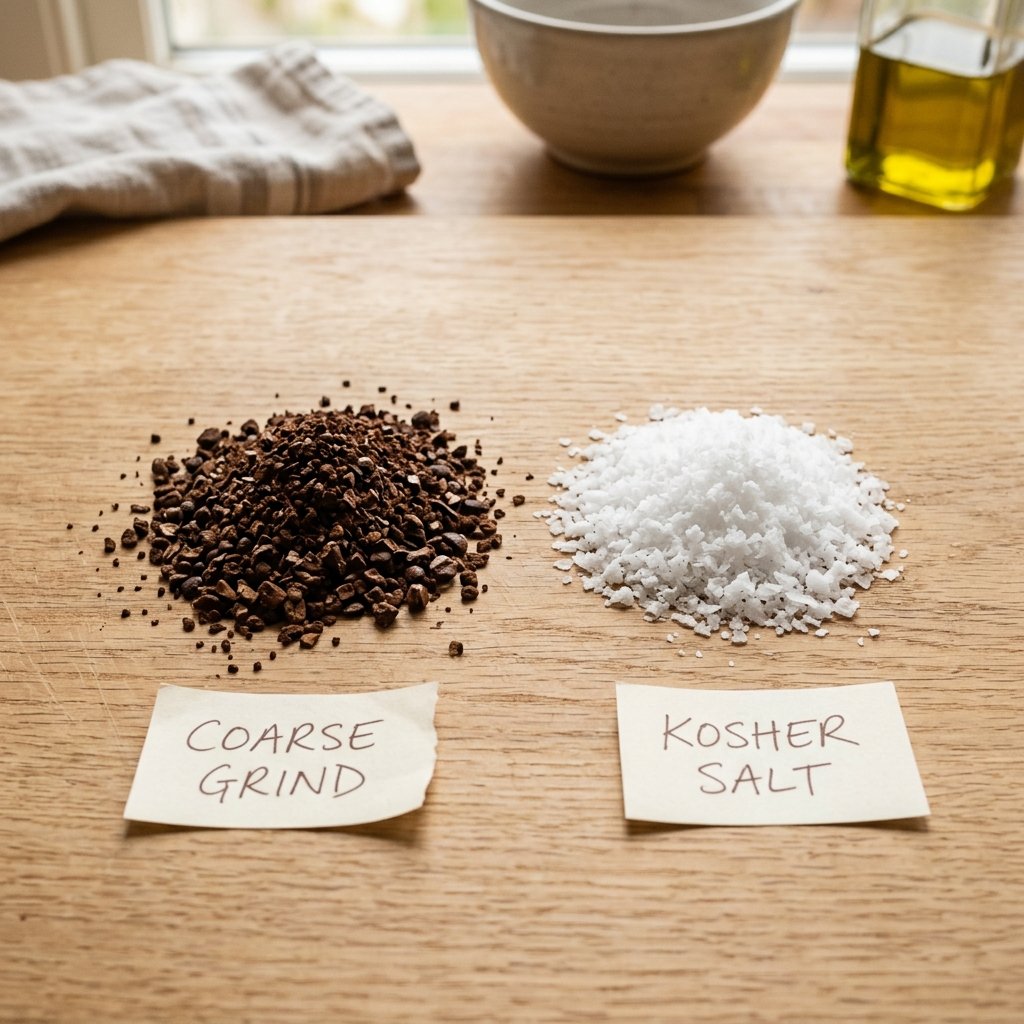
What you want: a coarse grind that looks roughly like kosher salt or sea salt flakes. The grounds should be chunky enough that you can see individual particles easily. If your grounds look like sand, they're too fine — and fine grounds in a French press are the main reason your coffee tastes muddy, bitter, or sludgy.
Why coarse? Two reasons. First, fine grounds slip through the mesh filter and end up in your cup (this is the sediment problem). Second, fine grounds extract way too quickly in an immersion brew — by the time the four minutes are up, you've over-extracted the coffee and pulled out bitter compounds that should have stayed in the grounds.
If you're grinding at home, set a burr grinder to its coarser settings. If you're having coffee ground at the store, ask for “French press coarse.” If all you have is pre-ground coffee from the grocery store, check the bag — most standard ground coffee is medium grind, which is too fine for French press. You can still drink it, but plan for a little more sediment in your cup.
For a full visual walkthrough with photos of different grind sizes, see our Coffee Grind Sizes Explained guide.
The French Press Coffee-to-Water Ratio
A “ratio” just means how much coffee you use compared to how much water. For French press, the sweet spot for beginners is 1:15 — that's 1 gram of coffee for every 15 grams of water.
If you don't have a scale yet, a rough conversion is 2 tablespoons of coffee for every 6 ounces of water. It's not as precise, but it'll get you close.
Here's a simple chart by French press size:
| French Press Size | Coffee (grams) | Water (grams / oz) | Makes |
|---|---|---|---|
| 12 oz (small) | 22 g | 330 g / 11 oz | 1 large mug |
| 17 oz (medium) | 30 g | 450 g / 15 oz | 1–2 mugs |
| 32 oz (large) | 54 g | 810 g / 27 oz | 3 mugs |
| 50 oz (extra large) | 85 g | 1,275 g / 42 oz | 4–5 mugs |
A few beginner-friendly notes on ratios:
- Want stronger coffee? Try 1:13 (more coffee, less water). Expect a more intense, café-style cup.
- Want lighter coffee? Try 1:17. Still rich, but easier to drink by the mugful.
- Always weigh both. Measuring by tablespoons or cups is close, but not precise enough to be repeatable. A $15 kitchen scale pays for itself in saved coffee within a few weeks.
For a full chart broken down by press size (and how to adjust to taste), see our dedicated French Press Coffee-to-Water Ratio guide. If ratios are brand new to you, our Coffee-to-Water Ratio Guide explains the concept from scratch.
Water Temperature and Steep Time
Two more variables — the last two you need to get right for a great cup.
Water Temperature
Aim for water at about 200°F (93°C). That's just off a rolling boil — most people don't have a thermometer handy, so here's the easy cheat: boil your water, then let it sit for about 30 seconds before pouring. That drops it into the right range almost every time.
Water that's too hot will over-extract and taste burnt or bitter. Water that's too cool (below 190°F) under-extracts and tastes weak and sour. The 30-second rest after the boil is one of those small habits that makes every cup better.
Steep Time
Steep your French press for four minutes from the time you finish pouring your water. Set a timer on your phone. Seriously — don't wing this one.
Why four minutes specifically? It's the sweet spot where enough of the coffee's flavor has extracted into the water, but before the harsh, bitter compounds start coming out. Coffee scientists and home baristas have tested this a lot, and four minutes has been the consensus for decades. For the full breakdown of what happens at each minute and how to adjust for stronger or milder cups, see our deep dive on how long to steep French press coffee.
A little more or a little less is fine — three minutes thirty seconds to four minutes thirty seconds is the safe range. But if you forget and it steeps for six or eight minutes, you'll taste it. The coffee turns harsh fast after that four-minute mark.
Don't leave your coffee sitting in the French press after it's done steeping. Even after you press the plunger, the grounds at the bottom are still extracting. If you're not going to drink it right away, pour the finished coffee into a thermal carafe or a mug. Coffee left in a French press for 20 minutes tastes nothing like coffee drunk right after plunging.
The Full French Press Brewing Process
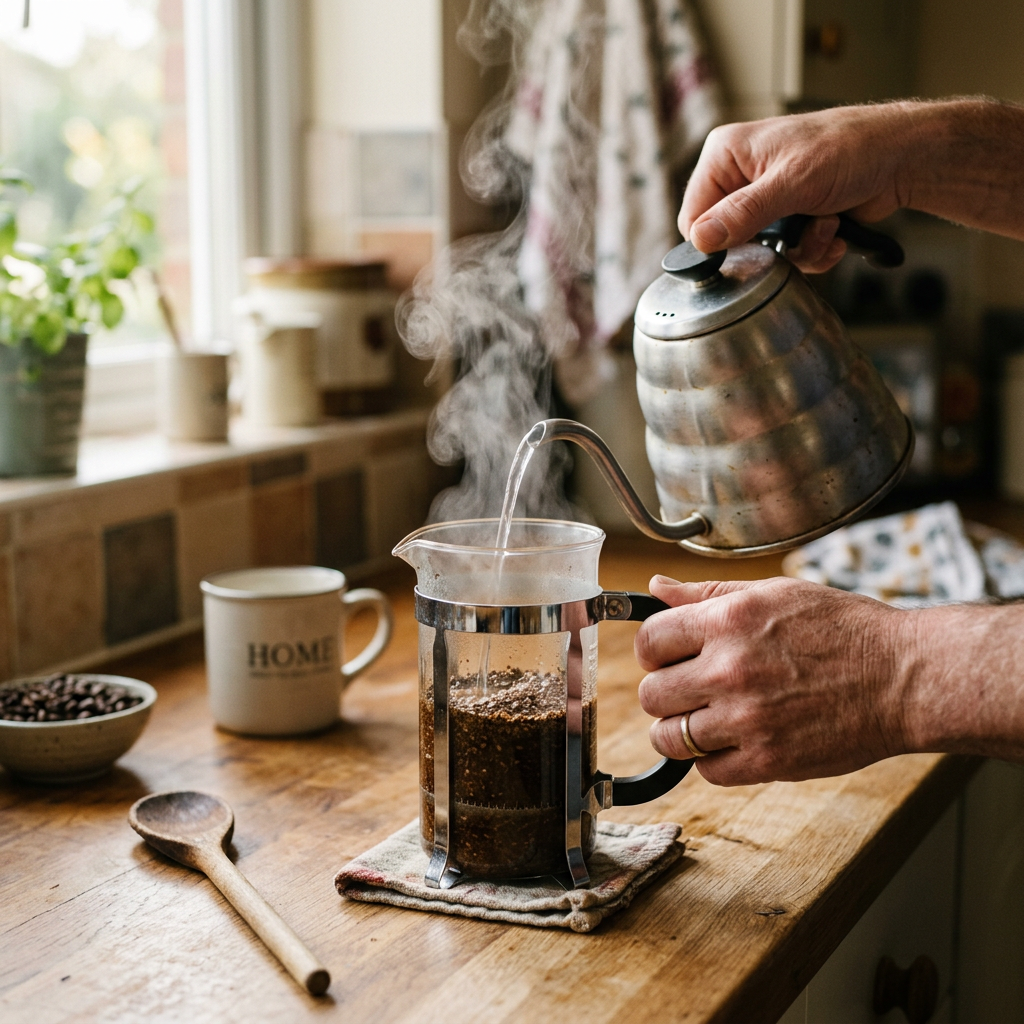
Here's the whole method from start to finish. Once you've done it a few times, it takes about five minutes of active attention.
- Boil your water. Use a little more than you need — about 20% extra — because you'll also use some to pre-heat the French press.
- Weigh your coffee beans. Use the ratio chart above to figure out how much you need for your French press size.
- Grind the beans coarsely. Kosher-salt texture. Whole beans stay fresh longer, which is why grinding right before brewing matters.
- Pre-heat the French press. Pour some hot water into the empty carafe, swirl it around, and dump it out. This keeps your final brew at the right temperature.
- Add the grounds. Pour your coarsely ground coffee into the pre-heated carafe.
- Start your timer and pour the bloom. Pour water equal to about double the weight of your coffee (for 30g of coffee, pour 60g of water). Give it a gentle stir to make sure all the grounds get wet. Wait 30 seconds. This “bloom” lets fresh coffee release CO₂ and gives you cleaner extraction.
- Pour the rest of your water. Fill to your target total weight in a slow, steady stream. Give the whole thing one more gentle stir.
- Place the lid on top with the plunger pulled all the way up. Don't press yet — the lid just keeps heat in while the coffee steeps.
- Wait for the timer. Total steep time from the start of your pour is four minutes.
- Plunge slowly. Press down with steady pressure for about 20 seconds. If you feel a lot of resistance, your grind is too fine for next time — don't force it.
- Pour immediately. Serve into mugs or a thermal carafe. Don't leave the coffee sitting on the grounds.
Common French Press Problems (And How to Fix Them)
If your first few brews don't taste great, don't give up. Almost every beginner French press problem comes down to one of four things: grind too fine, wrong ratio, water too hot or cold, or steep time off.
| The Problem | Most Likely Cause | The Fix |
|---|---|---|
| Bitter coffee | Grind too fine, or steeped too long | Go coarser. Keep steep to four minutes. |
| Weak or sour coffee | Not enough coffee, water too cool, or grind too coarse | Adjust to 1:15 ratio, use 200°F water, check your grind. |
| Muddy, sludgy cup | Grind too fine, or pressing the plunger too fast | Go coarser. Press slowly over 20 seconds. |
| Lots of grounds in the cup | Grind too fine, or filter is worn out | Go coarser. Inspect the mesh filter and replace if the wire is bent. |
| Coffee goes lukewarm fast | Forgot to pre-heat the carafe | Rinse the French press with hot water before brewing. |
If your coffee tastes bitter no matter what you do, grind is the first suspect. If it tastes weak, check your ratio and water temp. And if you're seeing a lot of sludge at the bottom of the cup, you'll want our dedicated guide on muddy French press coffee — it walks through the five most common causes in detail.
French Press vs Other Brewing Methods
A French press is a great starting point, but it's not the only way to make coffee at home. Here's how it stacks up against the other methods we cover. If you're specifically weighing French press against an automatic drip machine, our full French press vs drip coffee comparison walks through taste, time, cost, and cleanup side by side.
| Method | Best For | Cup Style | Difficulty |
|---|---|---|---|
| French Press | Forgiving daily brew, full-bodied coffee | Rich, heavy, some sediment | Easy |
| AeroPress | Fast brewing, easy cleanup, travel | Clean, smooth, strong | Easy |
| Pour-Over | Clarity and nuance, tasting different beans | Light, clean, bright | Medium |
| Moka Pot | Espresso-style coffee without a machine | Dark, concentrated, bold | Medium |
| Drip Coffee Maker | Hands-off brewing, big batches | Balanced, clean, familiar | Very Easy |
We've written full beginner guides on each method — if you want to compare brewing styles head to head, our sibling pillar is the natural next read: AeroPress Coffee: The Complete Beginner's Guide. The pour-over pillar is coming soon.
Cleaning and Caring for Your French Press
French presses are simple to maintain, but there are a couple of things worth knowing early.
After each brew, dump the wet grounds out as soon as possible. The easiest way: fill the carafe halfway with cold water, swirl it to suspend the grounds, and pour the whole thing into the trash (not the sink — wet grounds clog drains). Then rinse the carafe and give the mesh filter a quick scrub.
About once a week, take the plunger assembly apart and wash all the pieces separately. Coffee oils build up on the mesh filter over time, and those oils can turn rancid and start making your coffee taste stale. Warm water and a little dish soap work fine. Rinse well.
One warning that saves a lot of carafes: don't pour boiling water directly into a cold glass French press. The thermal shock can crack the glass. Either pre-heat with warmer water first, or let the boiling water rest for the 30 seconds we mentioned earlier — that's enough to prevent cracking in almost every case.
Beans Matter More Than Gear
This is the single most important thing we can tell a new French press user. Your beans matter more than your French press does.
A $25 French press with excellent fresh beans will make a better cup than a $100 French press with stale supermarket coffee. Every single time. Once you understand this, a lot of the advice you hear online stops feeling confusing — yes, gear helps, but beans are where the flavor actually lives.
Three rules for beginner-friendly coffee beans:
- Whole bean, not pre-ground. Coffee starts losing flavor the moment it's ground. If you can grind right before brewing, your coffee improves by a mile.
- Check the roast date. Look for a bag roasted within the last 2–4 weeks. “Best by” dates are not the same as roast dates — a bean can be “good” for a year but taste flat after two months.
- Medium or medium-dark roast is a safe starting point. Light roasts are harder to extract well in a French press. Dark roasts can taste burnt. Medium is forgiving.
For a deeper dive into picking great beans as a beginner, see our How to Buy Coffee Beans guide and Light, Medium, Dark Roast Explained.
Frequently Asked Questions
Is French press coffee stronger than drip?
French press coffee tastes stronger and heavier because it keeps the coffee's natural oils and fine particles in the cup — paper filters in drip machines trap those. The caffeine content is roughly similar, though, when you use the same amount of coffee. (For the full breakdown, see our French press vs drip comparison.)
Can I use pre-ground coffee in a French press?
Yes, but most grocery store pre-ground coffee is too fine for a French press and will give you a muddier cup with more sediment. If pre-ground is your only option, look for bags labeled “coarse” or “French press grind” — some brands make them specifically.
How long does French press coffee stay fresh after brewing?
About 20 minutes if it stays in the French press with the grounds at the bottom — after that, it keeps over-extracting and turns bitter. If you pour it into a thermal carafe, you can comfortably drink it within 30–45 minutes without a big flavor drop.
Why is there sludge at the bottom of my cup?
A little sediment is normal and part of the French press experience. A lot of sludge usually means your grind is too fine, your filter mesh has gaps, or you're pressing the plunger too fast. Our dedicated guide on muddy French press coffee walks through every cause.
Can I make iced coffee in a French press?
Yes — and it's one of the best ways to make cold brew at home. Use coarse-ground coffee, cold water, and a 1:8 ratio, then steep in the fridge for 12–18 hours before pressing. The French press basically replaces a fancy cold brew maker for free.
Key Takeaways
- French press is one of the most forgiving brewing methods for beginners — affordable, durable, and easy to learn.
- Use a coarse grind that looks like kosher salt. This is the single most important variable.
- Use a 1:15 coffee-to-water ratio as a starting point. Adjust stronger or lighter from there.
- Water should be just off a boil — about 200°F. Let your kettle rest 30 seconds after boiling.
- Steep for exactly four minutes. Plunge slowly over 20 seconds.
- Pour immediately after plunging. Don't let the coffee sit on the grounds.
- Fresh whole beans matter more than any piece of gear. Grind them right before brewing whenever you can.
What to Read Next
Now that you have the big picture, pick the next piece of the puzzle you want to go deeper on. Our full French press cluster has a focused article on every piece of this guide — grind size, ratios, troubleshooting, comparisons, and product picks. Start with the one that's most useful to you right now, and come back to this pillar anytime you need a refresher.
If French press is your method and you want a full product walkthrough, see our Best French Press for Beginners (2026 Picks) roundup — six honest picks at every budget. Want to see how French press stacks up against the other major beginner method? Our AeroPress Coffee: The Complete Beginner's Guide is the natural next read.
If you're still deciding between methods, our What Do You Need to Make Coffee at Home? guide is a good next stop.
Whatever you pick, the most important thing is to start. Make a cup. Then make another one tomorrow. You'll be surprised how fast this stops feeling complicated.
Disclosure: This article contains affiliate links. If you purchase through our links, we may earn a small commission at no extra cost to you. We only recommend products we genuinely believe are right for beginners. Full disclosure here.
☕ About the Author
Greg Rathbone is the founder of HomeCoffeeBeginner.com. He started this site after realizing most coffee advice online assumes you're already an expert. Every guide here is written for total beginners and tested in his own kitchen — no jargon, no snobbery.