
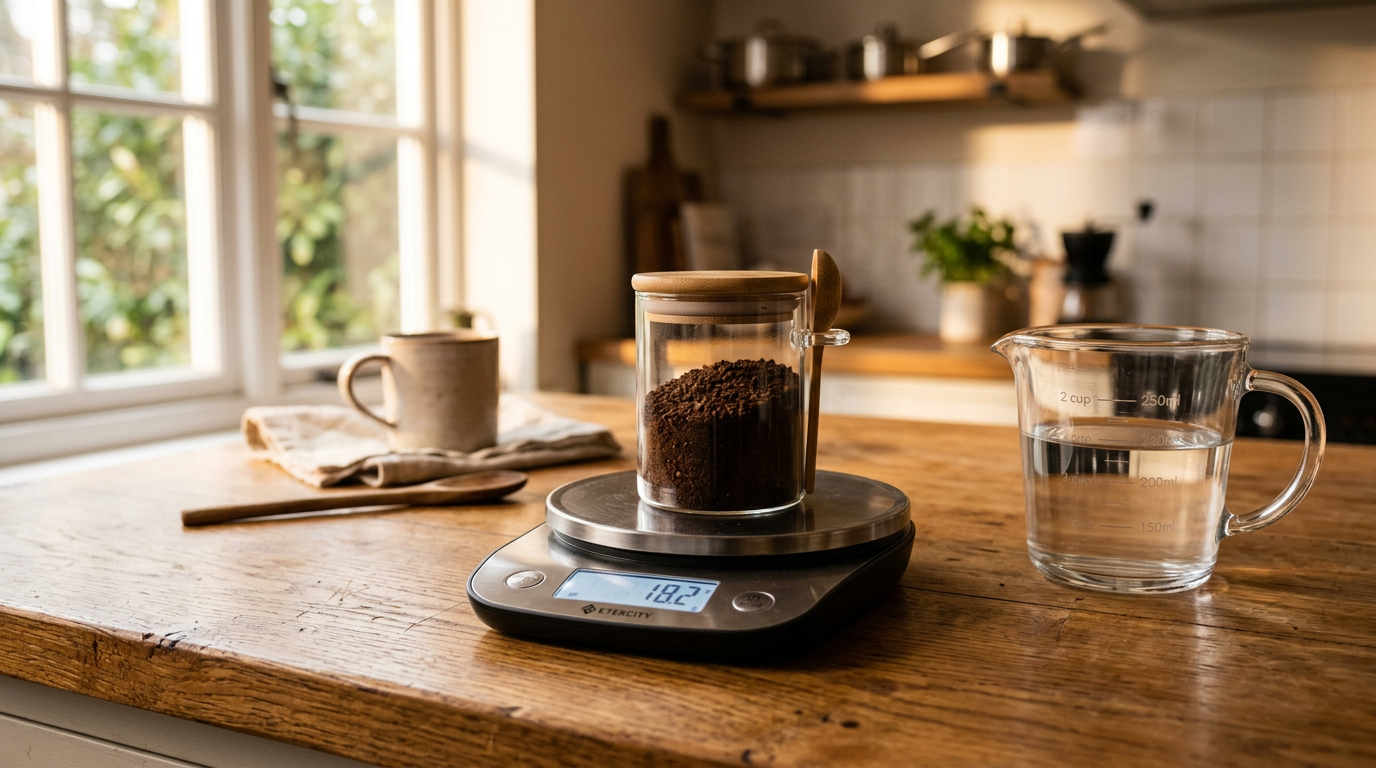
The standard coffee-to-water ratio is 1 gram of coffee for every 15–17 grams of water — or about 2 tablespoons of ground coffee per 6 oz of water if you're measuring by volume. Start there, then adjust to taste. More coffee = stronger cup. Less coffee = lighter cup.
If your coffee tastes off and you're not sure why, the ratio is usually the first thing to look at. Too weak and watery? You probably used too little coffee. Too bitter and harsh? You may have used too much — or too little water. Getting the coffee-to-water ratio right is the single most impactful thing you can do to improve your brew, and it's a lot simpler than it sounds.
In this guide, we'll break down what the coffee-to-water ratio actually means, how much coffee to use for different brewing methods, and how to adjust it to match your taste preferences. No scales required to get started — though we'll talk about why a scale eventually makes life easier.
If you're just getting your first cup going and need the full walkthrough, check out our guide on how to make your first cup of coffee at home first.
Free Interactive Tool
Skip the math — use our Coffee Brew Ratio Calculator
Pick your brewing method and number of cups. Get exact grams of coffee and water in seconds. Works for French press, pour-over, AeroPress, drip, Moka pot, and cold brew.
Open the Calculator →What Is the Coffee-to-Water Ratio?
The coffee-to-water ratio is simply the amount of coffee you use compared to the amount of water. It's usually written as a ratio like 1:15 or 1:16, where the first number is the coffee and the second is the water.
So a 1:15 ratio means: for every 1 gram of coffee, use 15 grams of water. A 1:17 ratio means every 1 gram of coffee gets 17 grams of water.
Here's the simple rule to remember:
- Lower number (like 1:12) = stronger, more concentrated cup
- Higher number (like 1:18) = lighter, more diluted cup
The Specialty Coffee Association (SCA) — the closest thing coffee has to an official standards body — recommends a ratio between 1:15 and 1:18 as the “golden zone” for a balanced, well-extracted cup. Most beginners do well starting right in the middle at 1:16.
How Much Coffee Per Cup? (With and Without a Scale)
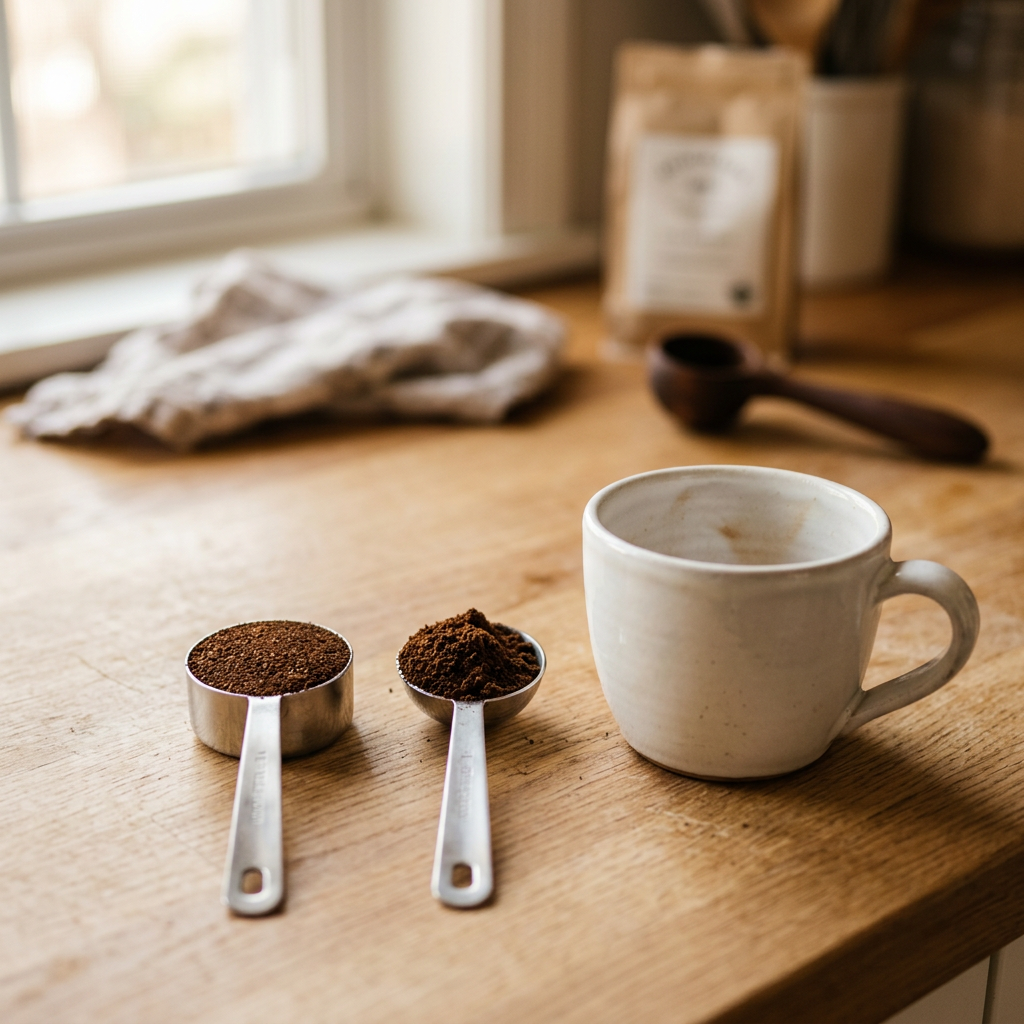
If you have a kitchen scale, measuring by weight gives you the most consistent results. But if you're just getting started and working with a tablespoon, that works too — here's the practical translation:
Measuring by Volume (Tablespoons)
| Cups of Coffee | Water | Ground Coffee |
|---|---|---|
| 1 cup (6 oz) | 6 oz | 2 tablespoons |
| 2 cups | 12 oz | 4 tablespoons |
| 4 cups | 24 oz | 8 tablespoons |
| Full pot (12 cups) | 72 oz | 24 tablespoons (about 1½ cups) |
Note: A “cup” on most coffee makers is 5–6 oz, not the 12 oz mug you're drinking from. So a “12-cup pot” makes about 72 oz — roughly 6 normal mugs.
Measuring by Weight (Grams)
| Water (grams / ml) | Coffee at 1:15 | Coffee at 1:16 | Coffee at 1:17 |
|---|---|---|---|
| 180g (6 oz mug) | 12g | 11g | 10.5g |
| 350g (12 oz mug) | 23g | 22g | 21g |
| 500g (small pot) | 33g | 31g | 29g |
| 1000g (large pot) | 67g | 63g | 59g |
Water and coffee both measure conveniently in grams — 1 ml of water weighs exactly 1 gram, so you can weigh your water directly in the kettle or carafe.
A simple kitchen scale is one of the best upgrades a home brewer can make. Tablespoon measurements vary based on how tightly the grounds are packed and how coarse the grind is — a scale removes that variable entirely. You don't need an expensive one: any scale accurate to 0.1g works great for coffee.
How the Ratio Changes by Brewing Method

Different brewing methods extract coffee differently, which is why the ideal ratio isn't identical across all of them. The good news: the differences aren't huge, and you can use the same tablespoon-based approach as a starting point for any method.
| Brewing Method | Ratio Range | Tablespoon Shortcut | Notes |
|---|---|---|---|
| Drip Coffee Maker | 1:15 to 1:17 | 2 tbsp per 6 oz | Most beginner-friendly starting point |
| French Press | 1:12 to 1:15 | 2.5 tbsp per 6 oz | Immersion brewing = slightly stronger ratio |
| Pour-Over | 1:15 to 1:17 | 2 tbsp per 6 oz | Similar to drip; adjust based on your taste |
| AeroPress | 1:6 to 1:15 | Varies widely | Highly flexible; start at 1:12 and experiment |
| Cold Brew (concentrate) | 1:4 to 1:8 | Very strong — dilute before drinking | Made as concentrate; add water/milk to serve |
If you're just getting started with drip coffee, stick with the 1:15–1:17 range. That's the sweet spot for most beginners and most coffee blends. You can explore the other methods once you've dialed in the basics — we have a full guide on choosing the right coffee maker for your brewing style if you're not sure where to start.
How to Adjust the Ratio to Your Taste
Once you've brewed a cup with the standard ratio, you'll know if you want it stronger or lighter. Here's how to adjust:
If your coffee tastes too weak or watery: Increase your coffee slightly — try adding half a tablespoon more per cup, or drop your ratio from 1:17 to 1:15. Don't add less water; just add a bit more coffee.
If your coffee tastes too strong or bitter: Reduce your coffee slightly — go from 1:15 to 1:17, or use half a tablespoon less per cup. Adding more water also works if you've already brewed the pot.
If your coffee tastes sour: A sour cup usually isn't a ratio problem — it's more likely an extraction issue (water too cold, grind too coarse, or brew time too short). The ratio is about strength, not sourness.
Only change one thing at a time when adjusting your brew. If you change the ratio AND the grind size AND the brew time all at once, you won't know what actually fixed the problem. Start with the ratio. If that doesn't help, try grind size next. One variable at a time.
Does the Type of Coffee Affect the Ratio?
A little — but not as much as most people think. Here's a quick breakdown:
Light roasts are denser than dark roasts, so a gram of light roast coffee has a bit more mass than a gram of dark roast. In practice, this means light roasts can handle slightly lower ratios (more coffee per water) to get the same extraction level. But for beginners, the difference is small enough that starting with the standard ratio works fine for any roast.
Dark roasts are more soluble — they extract faster and more easily. Some people find dark roasts taste great at slightly higher ratios (a bit more water per gram of coffee) to avoid bitterness. Again, start standard and adjust from there.
Pre-ground vs. whole bean doesn't affect the ratio directly, but it does affect how evenly your coffee extracts — which can make the same ratio taste very different. If you're grinding your own beans, check out our guide on what you need to get started with home coffee for equipment recommendations.
What About “Cups” on My Coffee Maker?
This trips up almost every beginner, so it's worth calling out clearly: the “cup” markings on your coffee maker are not the same as the mug you drink from.
A standard coffee maker “cup” is 5–6 oz. A normal drinking mug holds 10–12 oz. So when your machine says it's making 12 cups, it's actually producing 60–72 oz of coffee — which is closer to 6–7 normal mugs.
This matters for your ratio: if you're filling the reservoir to the “4 cup” mark (about 24 oz of water), use 8 tablespoons of coffee — not 4. Use the markings as a guide for water volume, not for how many mugs you'll end up with.
- The standard coffee-to-water ratio is 1:15 to 1:17 — or 2 tablespoons of ground coffee per 6 oz of water. That's your starting point for any brew.
- Lower ratios (more coffee per water) = stronger cup. Higher ratios (less coffee per water) = lighter cup. Adjust one direction at a time.
- Different brewing methods have slightly different ideal ratios, but they're all close — drip, pour-over, and French press all start in the 1:12 to 1:17 range.
- Coffee maker “cups” are 5–6 oz, not 12 oz — account for this when calculating how much coffee to use.
- A kitchen scale gives you the most consistent results, but tablespoons work fine when you're just getting started.
Getting Your Ratio Right
The coffee-to-water ratio is one of those things that sounds complicated but becomes second nature quickly. Start with 2 tablespoons per 6 oz of water, taste your cup, and adjust from there. Most people find their preferred ratio after just two or three brews — and once you've got it, every cup that follows gets better.
If you haven't brewed your first cup yet, our step-by-step guide on how to make your first cup of coffee at home will walk you through the whole process from start to finish — ratio included.
☕ About the Author
Greg Rathbone is the founder of HomeCoffeeBeginner.com. He started this site after realizing most coffee advice online assumes you're already an expert. Every guide here is written for total beginners and tested in his own kitchen — no jargon, no snobbery.