
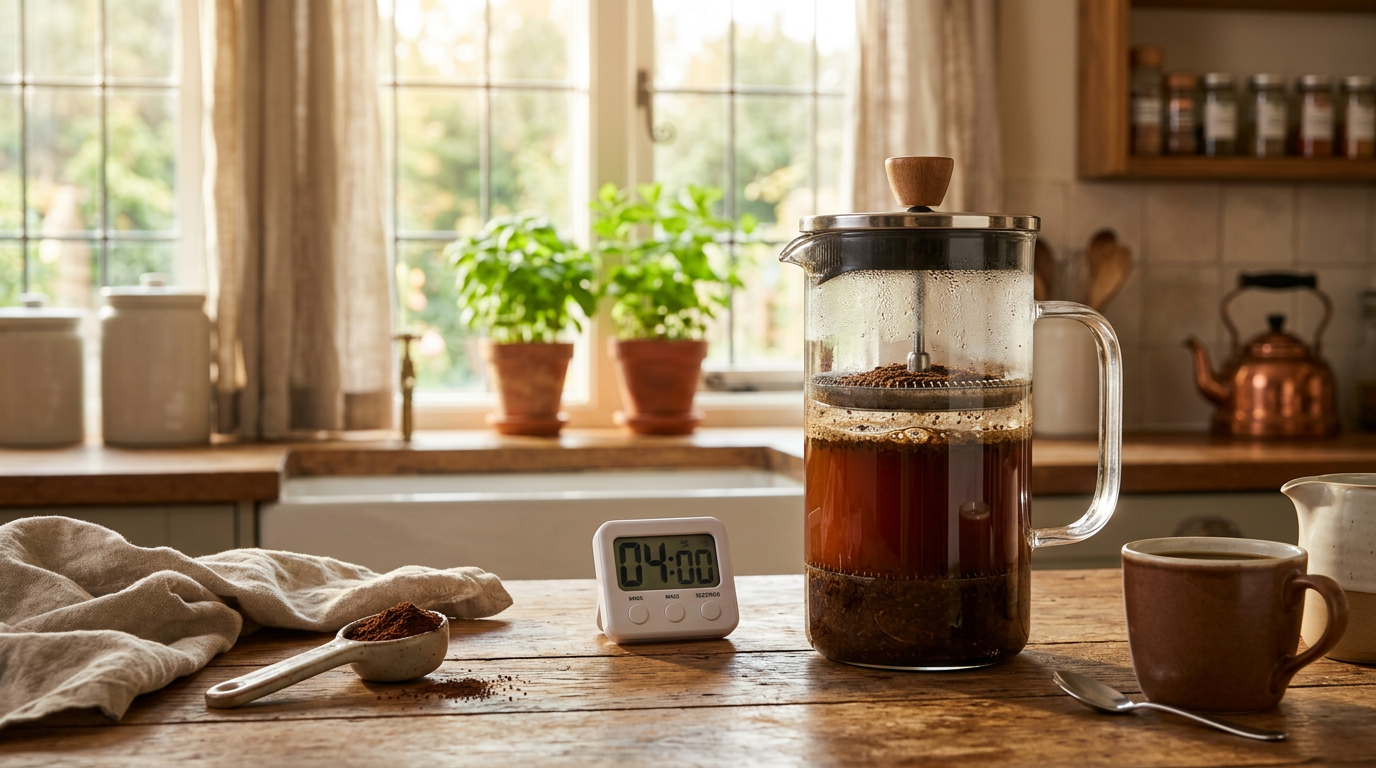
Steep French press coffee for 4 minutes. That's the sweet spot recommended by the Specialty Coffee Association — long enough to pull out the rich flavor, short enough to avoid bitterness. For a stronger cup, go to 5 minutes. For a milder one, try 3 to 3½. Anything past 6 minutes usually turns bitter and muddy.
If you've ever wondered whether you should set a timer for your French press — or just “wing it” — this one really does matter. Steep time is one of the four levers that control how your coffee tastes, and French press is especially sensitive to it because the grounds sit in the water the whole time.
The good news: the right answer is simple, and once you know it, you'll get a consistent cup every morning. In this guide, we'll walk through how long to steep French press coffee, why that exact time works, how to adjust it, and the common timing mistakes most beginners make.
If you're brand new to French press, start with our complete beginner's guide to French press coffee first — it covers the whole setup from gear to first pour.
How Long Should You Steep French Press Coffee?

The short answer is 4 minutes. That's the standard steep time recommended by the Specialty Coffee Association and used as the baseline by most serious roasters and coffee educators.
Here's the simple way to think about French press steep time:
- 3 minutes — milder, brighter, a little thin (okay for light roasts)
- 4 minutes — the classic, full-bodied cup most beginners love
- 5 minutes — stronger, heavier body, slightly more bitter
- 6+ minutes — usually over-extracted, bitter, and a little muddy
Start your timer the moment you pour the hot water over the grounds — not when you start heating the kettle, and not after the bloom. That 4-minute clock includes everything: the initial pour, the bloom, and the full steep. When the timer hits zero, press the plunger down slowly and pour right away.
The biggest mistake beginners make isn't picking the wrong number — it's not using a timer at all. Four minutes feels a lot longer than it actually is when you're staring at a press. Set a timer on your phone and walk away.
Why Does Steep Time Matter So Much?
Different flavor compounds in coffee dissolve into water at different rates. Understanding this one idea will explain almost every weird thing your coffee has ever done.
In the first minute or two, the acids and lighter, fruity aromatics extract first. Around the 3 to 4-minute mark, the sugars and body-building compounds come through — this is where the cup feels balanced and full. After about 5 minutes, the bitter compounds (mostly breakdown products of chlorogenic acids) start to dominate the extraction. Those are the harsh, woody, astringent notes nobody wants.
Four minutes at around 200°F hits a sweet spot. The acids and aromatics are fully dissolved, the sugars have had time to come through, and the bitter compounds haven't taken over yet.
That's also why French press uses a slightly different approach than drip or pour-over. Because it's an immersion brew — the coffee sits in the water the whole time — every second of steep time counts. A drip machine only exposes each ground to water for a moment as it passes through. A French press is a full bath.
After you press the plunger, pour the coffee out into mugs or a thermal carafe right away. Leaving brewed coffee sitting on top of the grounds keeps extracting — and by minute 8 or 9, you'll have a bitter, over-extracted cup even if your steep time was perfect.
Can You Steep French Press Longer for Stronger Coffee?

Technically yes, but it's usually the wrong lever to pull. If your coffee tastes too weak, most people's instinct is to steep it longer. That's a trap — you'll end up with bitter coffee, not stronger coffee.
For a stronger cup, adjust your French press coffee-to-water ratio first. Go from 1:15 to 1:13 (more coffee, same water). That gives you more flavor without pushing extraction into the bitter zone.
Only push your steep time to 5 minutes if you've already dialed in the ratio and grind size and still want a bit more body. Don't go past 5 minutes on a regular basis — once you're in the 6 to 7-minute range, you're just adding bitterness, not strength.
What If Your Coffee Still Tastes Off After 4 Minutes?
If you've steeped for exactly 4 minutes and the coffee still isn't right, steep time probably isn't the culprit. Check these other variables in this order:
Coffee tastes bitter or harsh: Your grind is probably too fine, or your water was too hot. French press needs a coarse grind — about like coarse sea salt. Our best grind size for French press guide shows exactly what that looks like.
Coffee tastes sour, thin, or watery: You're probably under-extracting. Try a slightly finer grind, check that your water is fully boiling and rested about 30 seconds (around 200°F), and make sure you're actually hitting the 4-minute mark.
Coffee tastes weak: Your ratio is probably off. Use more coffee, not more time.
Only change one variable at a time. If you tweak the steep time, the grind size, and the ratio all at once, you'll never know which one actually fixed the problem. Start with the ratio, then grind, then time.
Does Steep Time Change With Different Roasts?
A little, but less than you'd think for a beginner. Dark roasts extract faster because the beans are more porous — so if you're brewing a very dark roast, you can lean toward 3½ minutes instead of 4. Light roasts are denser and a bit harder to extract, so some coffee pros will push those to 4½ or 5 minutes.
For most beginners, stick with 4 minutes across the board. Dial in your ratio and grind first. Once those are locked in, you can experiment with 30-second steep-time tweaks to match your specific beans.
- Steep French press coffee for 4 minutes — that's the sweet spot for most beginners.
- Start your timer when you pour the water. When the timer hits zero, press and pour right away.
- Going past 5 minutes usually adds bitterness, not strength. For stronger coffee, adjust the ratio instead.
- Always pour the coffee out of the press after brewing — leaving it on the grounds keeps extracting.
- Change only one variable at a time so you know what fixed the problem.
Get the timing right and your French press coffee gets a whole lot more consistent. Four minutes, a timer, and a quick pour — that's really the whole trick.
☕ About the Author
Greg Rathbone is the founder of HomeCoffeeBeginner.com. He started this site after realizing most coffee advice online assumes you're already an expert. Every guide here is written for total beginners and tested in his own kitchen — no jargon, no snobbery.