
If you've been told to “buy a burr grinder, not a blade grinder,” you've already done the hard part. The next question trips up a lot of beginners: why is my new grinder made of so much plastic? Plastic hoppers can build up static and fling grounds everywhere, plastic burrs wear out, and a lot of people simply don't love the idea of hot, oily coffee touching cheap plastic every single morning.
The good news: you don't have to spend a fortune to get an all-metal grinder. Below are the stainless steel (and mostly-metal) burr grinders we'd actually recommend to a beginner who wants to skip the plastic. These are hand grinders, because that's where “no plastic” and “affordable” overlap best — and they grind beautifully for everything from cold brew to pour-over.
For most beginners who want a no-plastic grinder, the 1Zpresso Q2 is the best all-around pick — an all-metal body with stainless steel burrs, a comfortable size, and a price that won't scare you off. Want something even simpler and fully stainless? The Porlex Mini II is bombproof and pocket-sized.
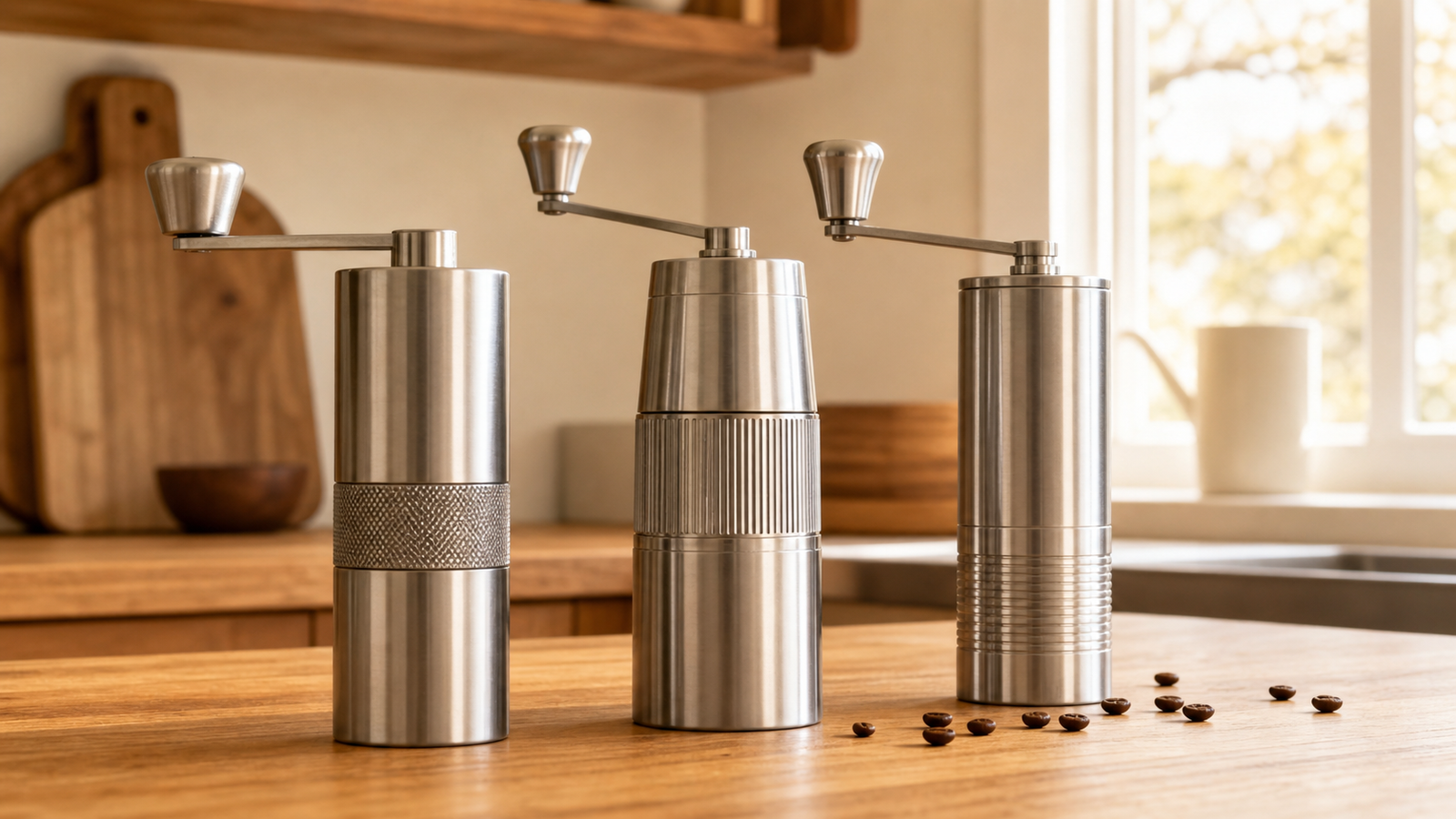
Why “no plastic” actually matters (and where it doesn't)
Let's be honest about this, because some of it is real and some of it is marketing.
Where it matters: The burrs are the part that does the grinding. Stainless steel burrs hold an edge far longer than the plastic or low-grade burrs you find in the cheapest grinders, so your grind stays consistent for years. An all-metal body also feels solid, won't crack if you drop it, and doesn't hold onto coffee oils and smells the way porous plastic can.
Where it's mostly preference: A plastic catch cup or a plastic knob isn't going to ruin your coffee. Plenty of excellent grinders use a little plastic for the lid or the grounds bin. So if you find a great grinder with a metal body and stainless burrs but a plastic cap, that's still a “no plastic where it counts” win. We've flagged below exactly which parts are metal on each pick so you can decide what matters to you.
Static cling (grounds sticking to the cup) is worse with bone-dry beans and dry winter air, not just plastic. A tiny spritz of water on the beans before grinding — the “RDT” trick, about one drop — kills static in any grinder, metal or not.
The best stainless steel / no-plastic coffee grinders for beginners
1. 1Zpresso Q2 — Best overall no-plastic grinder
If you want one recommendation and you're done reading, get this one. The 1Zpresso Q2 has an aluminum-alloy body, a stainless steel conical burr, and a metal grind adjustment that clicks into place so you can repeat your setting every time. It's small enough to hold in one hand, the build quality feels like something twice the price, and it grinds coarse enough for cold brew and French press and fine enough for pour-over.
For a beginner who wants an all-metal grinder that will still be going strong in five years, this is the sweet spot of price, quality, and “no plastic where it counts.”
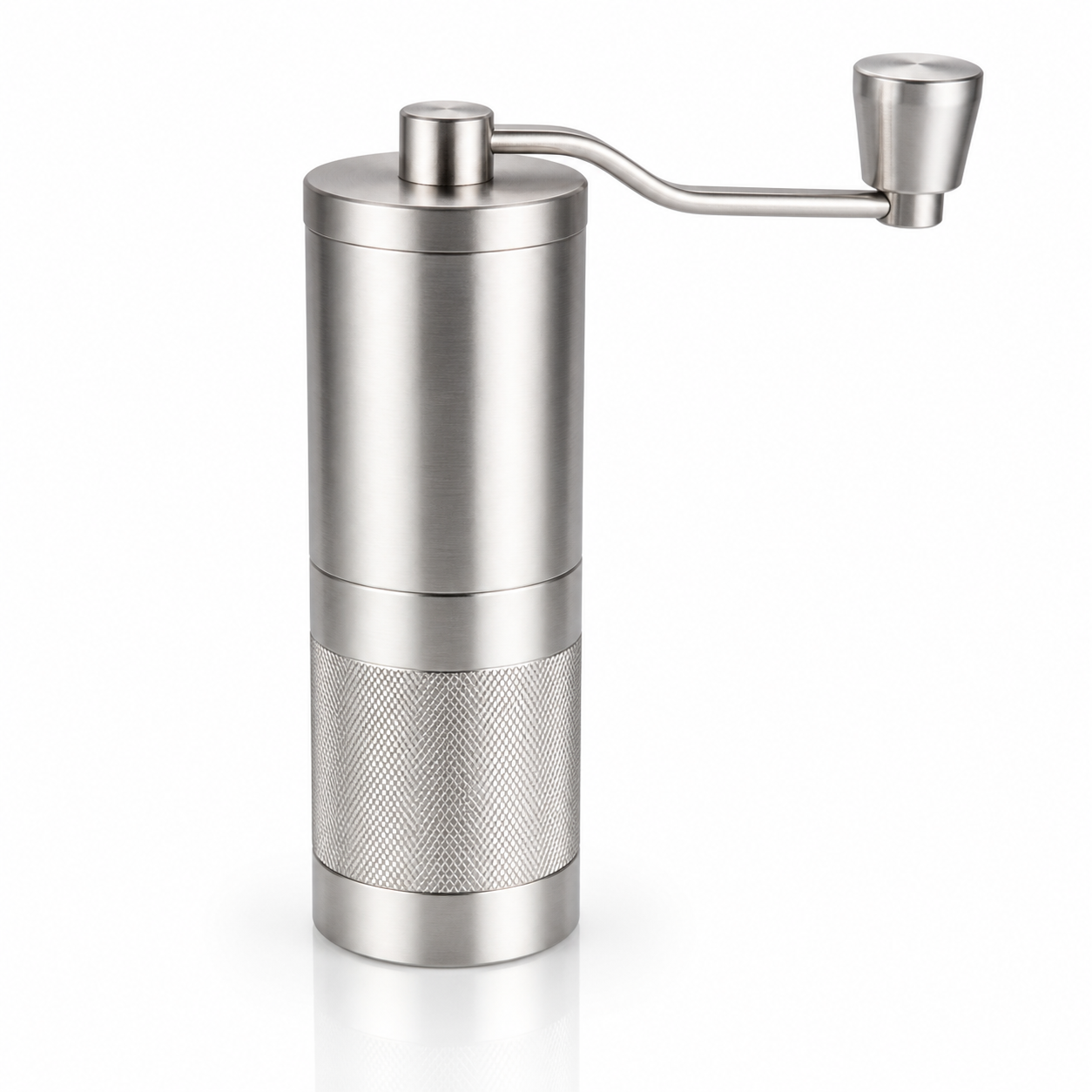
All-metal body, stainless steel conical burrs, repeatable click adjustment. The grinder we'd hand a beginner who wants to buy once and skip the plastic.
2. Porlex Mini II — Best fully stainless, simplest pick
The Porlex Mini II is about as close to “all stainless steel” as a grinder gets. The body, the burrs, and most of the working parts are stainless — there's barely any plastic to speak of. It's tall and skinny (it actually nests inside an AeroPress, if you have one), holds enough for one big mug, and the ceramic-coated steel burrs are tough and rust-proof.
It's a little smaller in capacity than the Q2 and the adjustment is a simple stepped dial rather than a numbered click, but for a beginner who just wants a rugged, no-fuss, no-plastic grinder, it's hard to beat.
3. Timemore Chestnut C3 — Best feel and speed
The Timemore C3 has a CNC-machined stainless steel burr set and an aluminum body, with grippy textured panels that make it genuinely pleasant to grind with. The “S2C” burr design chews through beans noticeably faster than older hand grinders, so you spend less time cranking. The grounds cup is metal too; only the small lid is plastic.
If part of your “no plastic” goal is also “I don't want grinding to feel like a chore,” the C3 is the one to look at.
4. KINGrinder K6 — Best for the future espresso fan
The KINGrinder K6 is all-metal — stainless steel burrs, aluminum body, metal external adjustment dial with lots of fine settings. The reason it's on this list: it has enough fine adjustment to grind for espresso and moka pot, not just coarse brews. If you suspect you'll graduate to a moka pot or a manual espresso maker down the road, the K6 grows with you without ever introducing plastic burrs.
5. JavaPresse Manual Grinder — Best budget option
If money is tight, the JavaPresse is the budget all-rounder we already recommend across the site. It has a stainless steel exterior and ceramic burrs (ceramic, not plastic — they stay sharp and won't rust), with 18 click settings. There's some plastic in the adjustment ring and cup, so it's not “100% metal,” but the burrs and body are the parts that matter, and the price is hard to argue with for a first grinder.
Already shopping for grinders? Our broader best coffee grinders for beginners under $100 guide covers electric options too, if you decide hand-grinding isn't for you.
A quick word on electric grinders and plastic
Here's the honest catch: at beginner prices, almost every electric burr grinder uses a plastic hopper and plastic catch bin. That's just the reality under about $150. If a fully no-plastic grinder is your priority and you don't want to spend a lot, a hand grinder is the way to go — and the bonus is they're quieter, smaller, and don't need an outlet. If you'd rather have the convenience of electric and can live with a plastic hopper, that's a perfectly reasonable trade — just know that “all-metal electric” mostly starts at higher price points.
How to choose, in one minute
- Want the easy answer? 1Zpresso Q2.
- Want the most stainless, least plastic, period? Porlex Mini II.
- Hate slow grinding? Timemore Chestnut C3.
- Think you'll try espresso or moka pot later? KINGrinder K6.
- On a tight budget? JavaPresse Manual.
Any of these will out-grind a cheap plastic blade grinder for the rest of its life. Pick the one that fits your budget and how you like to brew, and you're set.
- The burrs matter most — stainless steel (or ceramic) burrs stay consistent for years.
- Hand grinders are where “no plastic” and “affordable” overlap; most cheap electrics use plastic hoppers.
- Best overall no-plastic pick for beginners: 1Zpresso Q2.
- Most fully-stainless, simplest: Porlex Mini II.
Frequently asked questions
Are stainless steel burrs better than ceramic?
Both are good and both beat plastic. Stainless steel burrs grind a touch faster and handle heat well; ceramic burrs stay sharp a long time and never rust. For a beginner, either is a great choice.
Is it bad for coffee to touch plastic?
For the most part, no — food-safe plastic won't hurt your coffee. The bigger reasons to avoid plastic are durability (plastic burrs wear out) and static cling. If your grinder's body and burrs are metal, a small plastic cap is nothing to worry about.
Can these grinders do cold brew and pour-over?
Yes. Every grinder here adjusts from coarse (cold brew, French press) to medium-fine (pour-over). The 1Zpresso Q2, Timemore C3, and KINGrinder K6 can also go fine enough for moka pot.
Why is hand grinding recommended over electric for “no plastic”?
Because affordable electric grinders almost always use a plastic hopper and bin. All-metal electric grinders exist but cost much more. Hand grinders give you an all-metal build for far less.
Disclosure: Home Coffee Beginner is a participant in the Amazon Services LLC Associates Program. If you buy through links on this page, we may earn a small commission at no extra cost to you. We only recommend gear we'd be happy to hand a friend who's just getting started.
☕ About the Author
Greg Rathbone is the founder of HomeCoffeeBeginner.com. He started this site after realizing most coffee advice online assumes you're already an expert. Every guide here is written for total beginners and tested in his own kitchen — no jargon, no snobbery.
⚙️ Related Coffee Grinder Guides